Implementation of an AI Platform for Sales Training: Increased Conversion Rates
Find out how implementing an AI training platform speeds up onboarding, reduces stress, and boosts sales conversion rates. Learn how to get started.

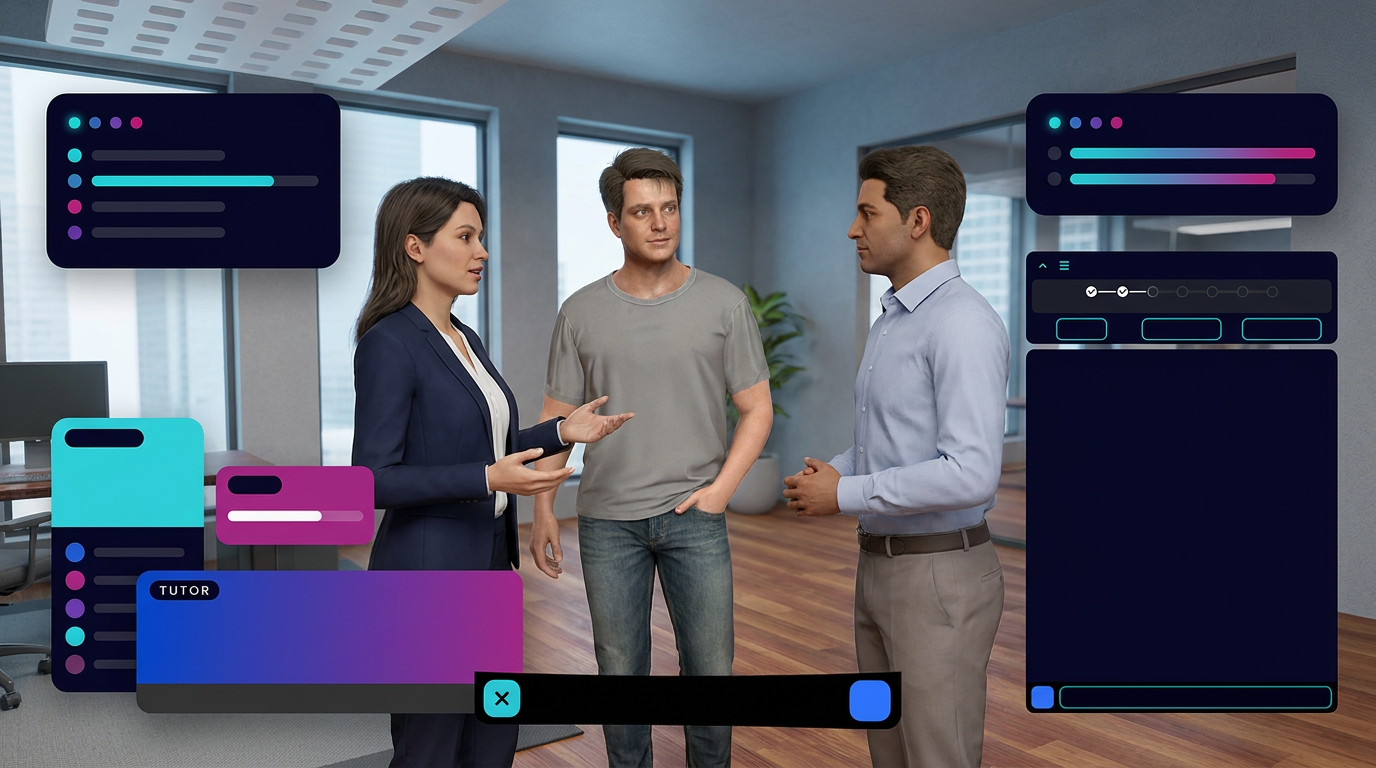
Sales pick up when a salesperson can conduct a difficult conversation like clockwork: from a strong opening, through the needs assessment, to a concise close and scheduling the next step. Implementing an AI training platform allows salespeople to practice this in realistic, safe conditions—with immediate feedback and without the risk of losing a sales opportunity. Instead of theory on slides, the salesperson converses with a realistic 3D avatar, observes emotions and reactions, and an intelligent coach suggests how to phrase things differently. The result? Less stress in real conversations, a shorter ramp-up period for new hires, and more predictable conversion rates in the sales funnel. Sound complicated? In practice, it’s simpler than you think—you can get started right in your browser, with no installation required, and if you want to boost the realism, there’s also a VR mode.
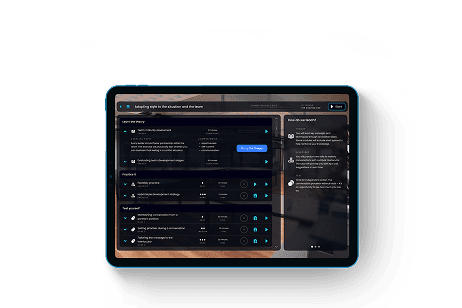
The key is to treat training as a business lever, not just an “L&D add-on.” That’s why implementing an AI platform for sales training is planned just like a revenue-growth campaign: with hypotheses, metrics, and short iteration cycles. The platform guides the user through the LEARN → PRACTICE → MASTER path, allowing you to move directly from theory to conversations and testing your skills without prompts. After the session, you receive an in-depth behavioral analysis—what went well, what needs improvement—and you know exactly what to work on before your next conversation. If you’re looking for a one-time “motivational” webinar, this isn’t the right fit—what matters here is regular practice, real-world scenarios, and an impact on your win rate.
What sales results does the AI platform deliver: a shorter ramp-up and higher conversion rates
The most noticeable change? A shorter ramp-up period. A new salesperson doesn’t have to wait weeks for “real” situations—they dive right in from day one, practicing openers, asking follow-up questions, handling objections, and closing out each step. Real-time AI coaching guides them through the conversation, and the subsequent session analysis shows where they lost momentum (e.g., a weak summary or a value proposition that was too general). In practice, after a few sessions, most people transition from a mode with prompts to full scenarios without support and begin to sound natural, not “textbook.” This translates to earlier first wins and a more stable pipeline.
The second area is conversions at key moments: from cold outreach to a meeting, from a demo to a proposal, and from a proposal to a win. When the team practices specific, repeatable scenarios—such as how to respond to “we already have a supplier” or “it’s too expensive”—the number of “dropouts” at the decision-making stage decreases. Realistic 3D avatars with emotions demand precision in language, and in sales, this makes a difference down to a single sentence. One organization (EFL) emphasized in a reference letter that the combination of VR, 3D avatars, immersive scenarios, and an effective feedback system significantly improved communication within teams—and we apply exactly the same discipline to sales conversations.
The third element is standardizing the conversation format without “stifling” individual style. The platform helps maintain a common framework (meeting structure, rules for asking questions, closing techniques), but leaves room for authenticity. Thanks to this, managerial coaching and self-analysis aren’t abstract—everyone sees the same stages and the same evaluation language. Want to see how this works in strictly sales-oriented scenarios? Check out our sales training programs and choose the areas that will deliver quick results for your team.
Step-by-Step Implementation of an AI Training Platform—From Pilot to Scaling
Successful implementation of an AI training platform starts with precise hypotheses: what do we want to improve, how will we measure it, and over what timeframe. Instead of “boosting sales,” identify 1–2 critical points in the sales funnel that are currently causing the most pain. Next, set up a short pilot with a selected group where it’s easy to collect comparative data. Once the results are confirmed, scale up to the rest of the organization by designing pathways for specific roles (SDR/BDR, AE, AM) and involving managers in coaching. This approach saves time, avoids chaos, and quickly builds a business case for broader adoption.
Needs Assessment and Scenario Selection for the Sales Team
Start with a conversation map: cold outreach, discovery, demo, negotiations, closing, upsell. Determine where conversion loss is greatest and what behaviors cause it (e.g., too few follow-up questions, moving too quickly to the presentation, failure to agree on the next step). Select 2–3 scenarios with the highest return potential and build your first learning path around them. Short modules work well here: LEARN (core knowledge), PRACTICE (conversation with an avatar and prompts), MASTER (a full conversation without support, followed by an analysis). At this stage, plan how managers will “link” feedback to specific sessions—this will facilitate later on-the-job coaching.
Pilot with a small group and success metrics
The pilot should be short and focused: 3–6 weeks, a small group (e.g., 8–15 people), and clear goals. The point is to quickly verify whether the hypothesis “this will increase conversion” holds up and where the scenarios need fine-tuning. Before you launch, establish a set of baseline metrics and how to collect them—some data is in your CRM, and some will be provided by the platform (e.g., number of prompts, conversation ratings, areas for improvement). If a metric doesn’t budge, don’t panic; sometimes all it takes is to refine the questions or reframe the metrics in the context of the customer.
- Time to first win with new prospects (ramp-up)—we’re cutting weeks, not days.
- Stage-by-stage conversions: contact → meeting, demo → offer, offer → win.
- Quality of the conversation during MASTER sessions (behavior assessment, e.g., clarity of purpose, questions, summary).
- Use of prompts and progress in subsequent sessions (sales rep autonomy).
- Module activity and completion rates vs. the team’s schedule (actual adoption).
After the pilot, conduct a brief retrospective: what worked, what didn’t, and what modifications to the scripts will improve results. Only then do you decide on a broader rollout—with a ready-made set of recommendations for managers and a communication plan for the team.
Scaling, personalized paths, and change management
When scaling, separate the paths by role and experience level: SDRs/BDRs focus intensively on lead generation and scheduling meetings; AEs focus on discovery and conducting demos; and AMs focus on upselling and post-implementation client follow-ups. Personalized paths increase the relevance of training and shorten the time needed to see real results. Establish routines: short sessions 2–3 times a week, 15–20 minutes each, with a quick debrief from the manager. A network of “champions” within the teams helps by showcasing recordings of effective conversations and sharing tactics. And one serious tip: don’t throw everything in at once—fewer, but well-refined scenarios work better.
Integration with the ecosystem: LMS, CRM, browser-based access without installation, and VR
The rollout should be seamless. The platform runs in a browser—immediate access, no installation required—and for teams seeking even greater realism, a VR mode is available. This allows you to integrate training into your daily workflow without having to ask IT for lengthy technical implementations. For many companies, it’s precisely this lack of barriers to entry that determines whether a project launches in a week rather than a quarter.
Integration with LMS and CRM systems is primarily about ensuring a meaningful flow of information: who has completed which modules, which skills are improving, and how this correlates with sales results. It’s not about technical bells and whistles, but about ensuring that the team and managers have insight into progress and can link it to conversions in real-world sales funnels. Realistic avatars with emotions and prompts during conversations help translate this knowledge into everyday interactions with customers—without “faking” the situation.
Want to see what a conversation with an avatar and post-session analysis look like? Simply schedule a demo and walk through a scenario that most closely reflects your reality. You’ll see how theory, live prompts, and the unsupported MASTER mode come together in practice—and at the end, you’ll receive a clear behavioral report.
Team Adoption and Manager Coaching: How to Reinforce New Behaviors
Adoption doesn’t happen on its own—it requires simple habits and support from leaders. A consistent rhythm works best: short sessions 2–3 times a week and a quick review in pairs or with a manager. After each session, it’s worth referring to the final analysis: choose one behavior to reinforce and one to improve before the next conversation. These are the “micro-loops” of change that truly stick. After a month, you’ll see that the way questions are asked and summaries are made stabilizes at a higher level.
The manager’s role? To make the coaching practical. Instead of vague comments like “be more specific,” the manager refers to specific parts of the session and points out which words or structures to use. A clear report based on the MASTER framework supports this effort—thanks to it, feedback is precise and constructive. That’s why modules focused on clear communication and providing feedback translate so quickly into the team’s day-to-day work—see what our soft skills training looks like in practice.
And a word of honesty: Let’s not beat around the bush—without managers, none of this will work. When leaders demonstrate their own sessions, share “best practices,” and link the results to the CRM, engagement skyrockets. After a while, one problem usually arises: overloaded schedules. The solution? Shorter but more frequent sessions and sticking to one goal per week instead of trying to “cover” everything at once.
ROI and Funding: Training Funding of Up to 100%
The return on investment is evident in three areas: faster ramp-up (less time to the first win), higher conversion rates at key stages, and time savings for leaders thanks to better, more concise coaching. Added to this is predictability—when the team works within the same framework, it’s easier to forecast and plan the pipeline. Importantly, we’re talking about behaviors that directly translate into revenue, not abstract “competencies without context.”
You can fund the implementation of an AI-powered training platform through external financing—subsidies covering up to 100% of the costs are available. This significantly lowers the barrier to entry and allows you to start with a pilot program without any budgetary risk. If you’re considering developing your sales team using this model, check out subsidized sales training programs and explore your options.
How do you calculate ROI? The simplest way: compare baseline conversions and ramp-up figures from before the pilot with those after 4–6 weeks of working through scenarios. Add the time leaders save thanks to more precise feedback (fewer long, general conversations; more short, to-the-point interventions). If your organization doesn’t measure these metrics or doesn’t plan to integrate data with your CRM, this approach will be a poor choice—it’s a solution for companies that want to see the impact “in the numbers.”
Process Quality and Security: ISO 9001:2015 Certification in Practice
Quality in training isn’t just a slogan—it’s a process. ISO 9001:2015 certification means that the way modules are designed, delivered, and improved is structured, documented, and regularly audited. As a result, scenarios are consistent, and feedback is repeatable and comparable across teams. In practice, this provides stability: you know what to expect from each learning path and how to interpret the results.
For sales, this translates to implementation reliability: clear evaluation criteria, a predictable content update schedule, and specific mechanisms for responding to user feedback. The improvement loops work here much like they do in a good sales process—quick feedback, correction, and retesting. This builds trust in the platform and facilitates communication with stakeholders who need formal quality assurances.
If you’re bringing together teams from different countries or units, standardization offers an additional benefit: the comparability of results regardless of context. The same module, the same metrics, similar expectations—while still allowing for the personalization of paths based on role and level of experience. It is precisely this balance between repeatability and flexibility that enables the platform to keep pace with change and effectively support revenue growth.