
E-learning
- Real conversation practiceNo
- Individual practiceNo
- Repeat as many times as neededNo
- Immediate feedbackQuiz / test
- Scalable across the organizationYes
Map how people communicate, lead and respond in realistic conversations — and turn every simulation into measurable development data.
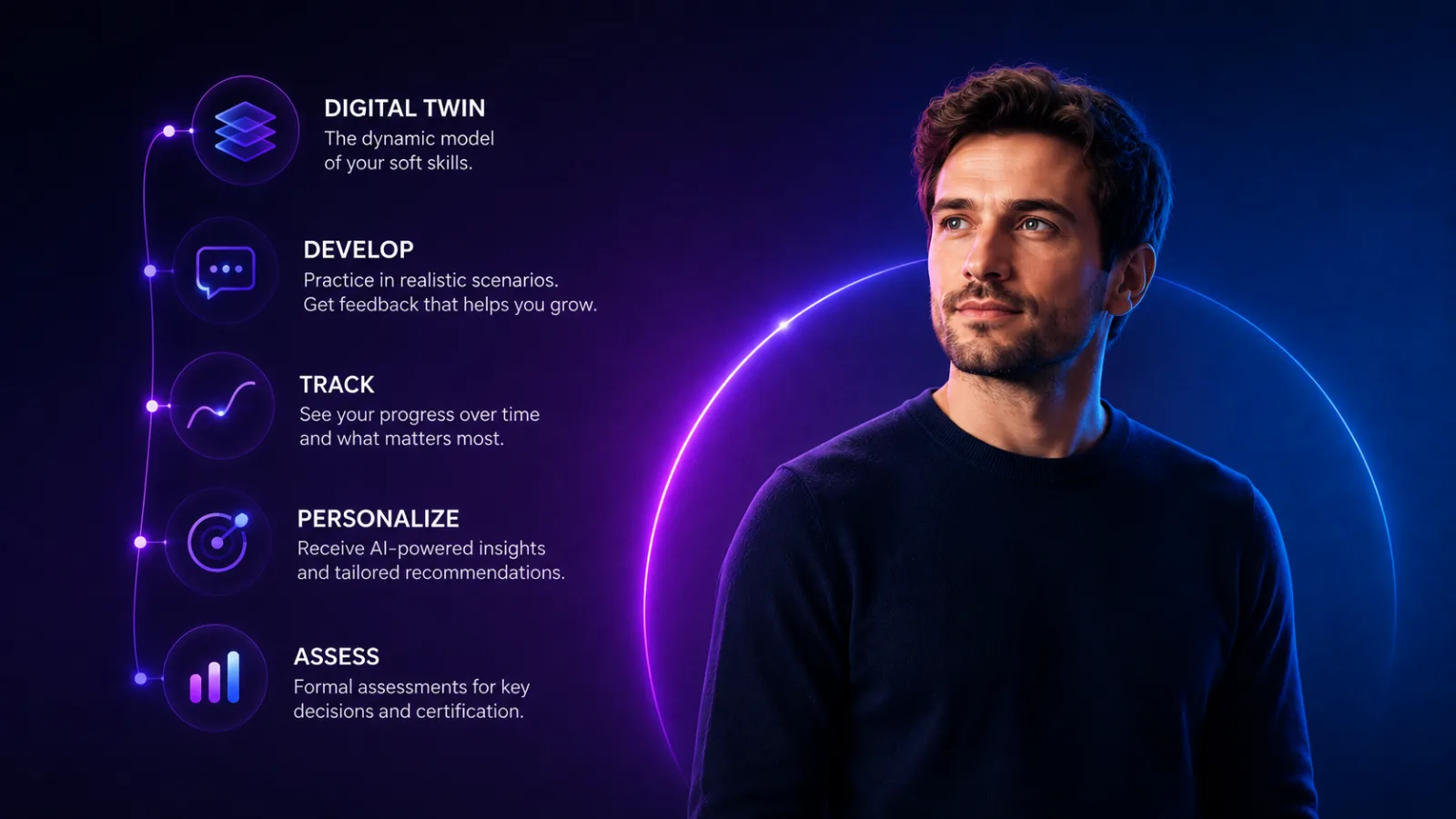
How strongly a competency is demonstrated across valid behavioural samples and conversation contexts.
Which behaviours are effective, repeatable and visible in different scenarios.
Where performance is inconsistent, context-dependent or not yet sufficiently demonstrated.
How the user’s behaviour changes across multiple simulations and difficulty levels.
How competencies show up in different relationships, scenarios and moments of pressure.
How the user’s behaviours fill different areas of the competency model: relationship, task, change and system orientation.
Which simulations, skills or behaviours should be practised next.

See it live
A realistic AI avatar that reacts to your words, shows emotion, and gives you an instant coaching read. Here's a sample feedback conversation.
TELL MARGO WHAT'S GOING ON
Auto-playing sample · this is exactly how the real avatar responds
FROM LEARNING TO DOING
E-learning is great for delivering knowledge. Workshops let people practice it. But real skills are built through repeated attempts, feedback and the opportunity to try again. Metaskills gives every employee a safe space to practice real conversations whenever they need it.
E-learning mainly ends at Learn.
Workshop reaches Practice and Feedback, with a limited number of attempts.
Metaskills covers the full loop: Practice, Feedback, Repeat, Improve.
Learn
Efficient way to deliver knowledge at scale.
Learn + practice
Live practice and human feedback, limited by trainer time and group format.
Practice. Improve. Repeat.
Individual practice of real conversations with immediate feedback and the ability to repeat.
A trainer can only run so many conversations at once. Metaskills makes practice available across the whole organization. No pressure. No audience. Immediate feedback and the freedom to try again.
COMPLEMENTARY, NOT REPLACEMENT
Metaskills extends training beyond the classroom. Before a workshop. Between sessions. After training. Or as a standalone practice program.
Metaskills is more than a conversation with AI. Each simulation defines the role, context, objectives, character behavior and assessment criteria. After the conversation, the user receives structured feedback, while the organization can track practice and development over time.
See how a simulation worksReady to move from learning to doing?
Managers rehearse difficult conversations with their team — delegation, conflict, performance — and see which behaviours hold up under pressure and which need work.
Clinical teams practise breaking bad news, gaining consent and calming distressed patients, with feedback on empathy, clarity and the structure of the conversation.
People practise giving and receiving feedback before it matters — so praise, correction and peer-to-peer conversations become routine rather than an annual event.
Agents handle complaints, escalations and demanding callers in simulation, and see how tone, questioning and de-escalation change the outcome of the conversation.
Teams rehearse reacting to exclusion, bias and awkward remarks — turning an inclusion policy into concrete sentences people can actually say in the moment.
New joiners practise the conversations of their role from day one and start with a baseline profile that shows where support is needed, before habits set in.
You see which behaviours a person shows across scenarios, not just who speaks up — a starting point for development conversations — formal decisions rest on AI Assessment.
Formal evaluation is a separate use case: AI Assessment, with defined criteria and human oversight. Digital Twin itself stays a development layer.

18 competencies in four domains and 108 behavioural scenarios - why a functional taxonomy rather than a personality model, and what a competency description contains.
The competency modelWhat counts as proof of a competency and what does not, why confidence is stated openly, and why we never average session scores.
How behaviour becomes evidenceThe study design, published before the results: the same scenario with an AI avatar and with a human actor, scored by independent assessors.
Testing assessment against human assessors