
AI Sales Role Play Training
Sell more. Spend less.
Browser or VR • real-time coaching • feedback after every conversation
What is AI sales role play training?
Metaskills clients






How an AI sales role play session works
Scenario
Choose the conversation
Pick the sales situation your team finds hardest. We build the scenario from your products, typical objections and sales materials.
Learn
Refresh the technique
Before the conversation, short slides recap the key concepts the rep is about to use, such as discovery questions or answers to a price objection.
Practice mode
Talk to the AI buyer with hints
The rep speaks or types and the buyer answers in character. Real-time guidance suggests a better move while the conversation is still going.
Master mode
Run it again without hints
When ready, the rep repeats the conversation with no prompts and no live feedback - the closest thing to a real call.
Feedback
See what decided the outcome
The rep gets the full transcript, strengths, areas for improvement and specific alternatives to what they said, tied to that buyer and that moment.
Digital Twin
Try again and watch the profile grow
Every conversation updates the rep's Digital Twin: proficiency levels, progress over time and what to practise next. The avatar never gets tired and never judges, so a mistake costs nothing more than another attempt.
Sales role play scenarios we build for your team
Built to order
Cold call
The buyer did not expect the call and wants to end it quickly. The rep practises giving the buyer a reason to keep talking and agreeing a next step.
Built to order
Discovery call
The prospect gives short, guarded answers. The rep practises open questions, follow-up questions and summarising needs before saying a word about the product.
Built to order
Product demo
The buyer has seen similar offers before. The rep practises linking each feature to a need the buyer has named.
Built to order
Objection handling
"It's too expensive." "Just send me a proposal." The rep practises finding out what is behind the objection, answering with value before reaching for a discount and keeping the conversation open.
Built to order
Negotiation and margin protection
The buyer wants a lower price, longer payment terms and extras all at once. The rep practises trading concessions instead of giving them away.
Built to order
Closing
The conversation went well, but the buyer hesitates. The rep practises surfacing the last doubts and asking for the decision.
Built to order
Upselling and cross-selling in retail
A customer came in for one product. The store employee practises asking about the need behind it and suggesting a relevant addition without sounding pushy.
Built to order
Meeting a senior executive
The decision maker has little time and no patience for product detail. The rep practises opening with the business problem, keeping it short and agreeing a clear next step.
Built to order
Renewal and churn risk
An existing client is unhappy and looking at other options. The rep practises listening, owning what went wrong and rebuilding the case for staying.
Is your team's toughest sales conversation missing from the list? Describe it and we will propose a pilot built around it.
Design a pilot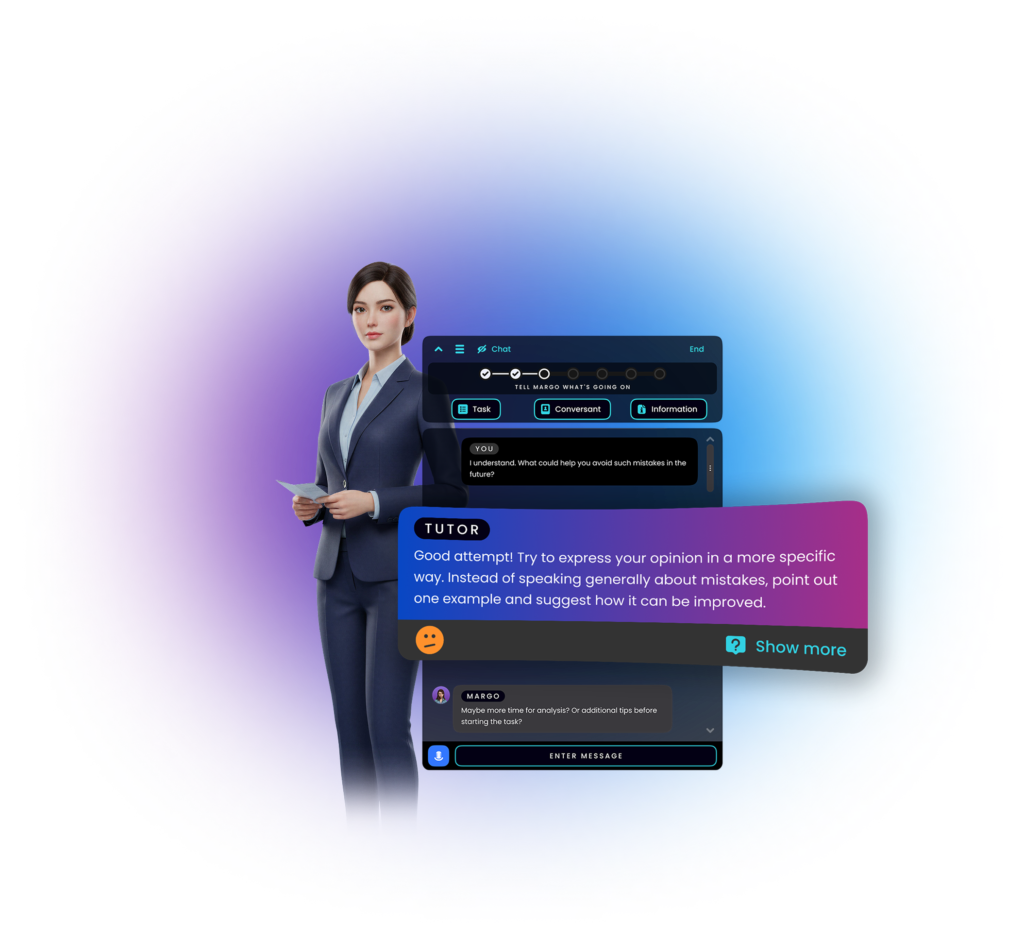
AI buyers that react like real customers, with real-time coaching
An AI buyer in Metaskills is not a scripted chatbot. Every scenario is designed using a defined methodology: the avatar has a set personality, a goal and a context, and the feedback criteria are fixed in advance. Buyers can be sceptical, pressed for time, fixated on price, or senior and impatient with detail, and they react to the words the rep actually uses. In Practice mode, real-time guidance helps the rep notice when they stay too general, skip a question or answer push-back with more pitching. The rep can correct course while the buyer is still listening. After the call, the rep gets the full transcript with the moments that decided the outcome, plus specific alternatives to what they said - not general advice about communication.
See the Digital TwinBuilt on your sales process, products and terminology
Your products and objections
Scenarios start from real conversations in your organisation: your offer, the objections your reps hear and the situations that cost you deals.
How we build simulationsYour sales methodology
Assessment criteria follow your own sales process, so the feedback reinforces the way your team is expected to sell.
See the methodologyYour customers and language
Avatars reflect your customers, from a store visitor to a senior decision maker, and use your terminology. Your experts review and test every simulation before rollout.
Start with a pilotAI role play vs traditional sales role play
Availability
Traditional role play: a session booked with a trainer or a manager. AI role play: any time, as often as the rep needs.
Audience
Traditional role play: often in front of colleagues, so some reps play it safe. AI role play: one to one with the avatar, no audience.
The customer
Traditional role play: a colleague improvises the buyer, differently each time. AI role play: the same persona, goal and objections on every attempt.
Feedback
Traditional role play: general impressions after the exercise. AI role play: feedback tied to exact moments, with alternatives to what was said.
Progress
Traditional role play: remembered by the people in the room. AI role play: recorded in each rep's Digital Twin and visible as team trends.
Trainers and managers
AI role play complements them rather than replacing them: use it before a workshop, between sessions or after training.
From learning to doingWhen to start AI sales role play
Onboarding new reps
New reps practise the typical conversations of their role from the first day, as often as they need. Their first real customer meeting is no longer their first attempt.
New product launch
The whole sales network practises the pitch and the answers to the first customer questions at the same time, without booking rooms or trainers. Feedback after each conversation shows every rep whether the message lands.
Targeted coaching
Team-level trends show which skills are not moving yet, such as closing or price negotiation. The team keeps practising exactly those conversations instead of repeating the whole programme.
Sales role play built for your industry

Retail & FMCG
Sales and service conversations across store networks: needs discovery on the shop floor, upselling and cross-selling, a complaint at the till and one service standard in every location.

Finance and banking
Consultative conversations where trust decides: understanding the client's situation before recommending a product, explaining terms clearly and answering doubts within the rules of regulated communication.

B2B & SaaS
Longer sales cycles with several decision makers: discovery with a champion, a demo tied to business needs, a senior executive with little time and negotiation with procurement.

Sales role play in the browser or in VR
The same sales scenario runs in two versions. In a web browser there is nothing to install. It is the easiest way to roll practice out across a whole sales team or store network, at the office, at home or between customer meetings. VR adds immersion for onboarding, sales kick-offs, events or advanced learning. We rent out plug-and-play VR kits with pre-installed software, so there is no need to buy headsets.
How the platform worksWhat reps and sales leaders see after AI role play
Feedback for the rep
Each rep sees their own transcript and feedback after every conversation, measured against criteria fixed for that scenario - coaching material, not an audit trail.
Digital Twin profile
Every attempt updates the rep's skill profile: progress over time, a comparison of repeated attempts and what to practise next.
How the Digital Twin worksTeam trends for managers and L&D
By default managers and L&D see team-level trends: how much practice happens and which skills are moving or stalling. Business results such as ramp-up and conversion stay in your own systems, and a pilot shows whether to continue.
Analytics and reportingSecurity and data
Hosted in the EU
Production infrastructure and customer data are hosted in the European Union. Data is encrypted in transit and at rest.
Data Processing Agreement
We provide and sign a Data Processing Agreement on request, setting out how personal data is processed in line with the GDPR.
Your data does not train AI models
We do not use customer data, conversations or transcripts to train AI models. The AI model receives only the content a specific function needs.
Security and dataHow to start: a pilot with one sales team
Describe the situation
Tell us which sales conversation you want to improve, such as a price objection or a difficult renewal call. Examples and sales materials help, but a short description is enough to start.
We build and run the pilot
We build the AI simulations with your materials and launch them for a selected group of reps. They practise in the browser; VR is optional.
Decide on the evidence
We analyse usage, repeat attempts and behaviour change. You get the conclusions and decide whether to continue or stop.
AI sales role play training: FAQ
What is AI sales role play?+
How does AI sales role play training work?+
What sales role play scenarios can a team practise with AI?+
Does AI role play replace role play with a sales manager or trainer?+
Do sales reps need a VR headset to train?+
Can we use our own products, objections and sales methodology in the scenarios?+
Can we test AI sales role play on one scenario before a full rollout?+
How do you measure the results of AI sales training?+
Can AI sales role play help onboard new sales reps?+
How much does AI sales training cost?+
Start with one sales conversation
Book a demo to talk to an AI buyer and see the coaching and feedback yourself, or describe one sales situation and we will propose a pilot built around it.