Sales Training KPIs That Actually Drive Sales
Discover the KPIs for sales training that link behaviors to funnel stages and actually boost conversion rates. Specific metrics + reporting frequency—check them out.

Sales training KPIs show whether training is changing salespeople’s behavior in customer conversations, moving opportunities through the pipeline, and improving commercial results. The most useful metrics connect observable behaviors with funnel stages, margins, and ROI, so you can build a focused dashboard instead of measuring attendance or workshop satisfaction alone. In this article, I’ll show you which KPIs to track at each stage, how to combine leading and lagging indicators, and how AI simulations can provide data for comparing training with CRM results.
In this article, I’ll guide you from defining effective KPIs, through embedding them in the sales funnel, to measuring results using AI simulations. I’ll also show you how to integrate this with your CRM and calculate your return on investment—without an excess of slides, but with data that the sales team can understand in a second. If you want to see how this works in practice, take a look at our sales training programs—they’re based on realistic scenarios and short modules that are easy to fit into your schedule. The whole thing has one goal: to move learning from theory to repeatable practice, and then translate it into numbers in the pipeline. And all this without organizing huge “events,” but through systematic training and clear metrics.
Why KPIs in Training Matter for Sales Results
Without a link to business results, training becomes a fixed cost rather than a revenue driver. When KPIs reflect behavior in real conversations with customers, you begin to see what truly moves things forward. Here’s a quick example: if, after training, the percentage of calls in which a salesperson establishes the agenda and agreement on the goal within the first 30 seconds increases, the number of scheduled meetings usually increases as well. In practice, after a few weeks, dialer reports show a shorter time to get to the point and fewer “not now” responses that get put off indefinitely. These are the signals that precede results—and thanks to them, you can quickly adjust course.
Good KPIs establish a “line of sight” from individual behaviors to revenue. First, leading indicators (e.g., percentage of calls with a proper opening, number of in-depth issues addressed during a meeting, effectiveness rate in addressing objections), then outcome indicators (scheduled meetings, conversions between stages, margin). When you combine these, you’ll know which elements of the conversation are real levers for change and which ones just look good on paper. This allows you to invest your time in things that actually change behavior and results, rather than in general “skill-building” with no data to back it up.
There are also situations where KPIs don’t make sense—and it’s worth saying so outright. If you’re looking for a one-time team-building event with a motivational element, forget about sales metrics; here, the goal is the atmosphere, not the pipeline. However, if your ambition is stable, predictable sales, KPIs must be embedded in the process and measured in real time. Without integrating data? No way. It’s a bit like driving a car without a speedometer—you’re moving, but you don’t know if you’ll get there on time.
The Most Important Sales Training KPIs at Every Stage of the Funnel
The top of the funnel is all about the pace and quality of the first contact. Here, sales training KPIs that measure the following prove effective: the percentage of calls with the right opening (agenda + value + consent), the time to the first valuable piece of information from the customer, and the conversion rate from a call to a scheduled meeting. Add a focus on QUALITY, not just quantity: the percentage of calls without “slips of the tongue” like a sales pitch in the first minute, and the quality of tone and speaking pace. These are the precise “adjustments” that can be fine-tuned through training and that influence the number of opportunities in the CRM.
The middle of the funnel is about diagnostics and value. Measure the average number of identified issues per meeting, the percentage of calls that quantify the cost of inaction, the number of agreed-upon decision criteria, and a confirmed stakeholder map. Good soft skills training teaches you to ask questions that not only “probe” but also guide the client toward a business conclusion. If the proportion of conversations in which a concrete value hypothesis is presented increases, the number of offer iterations typically decreases.
The bottom of the funnel consists of objections and negotiations. Here, KPIs should track the percentage of objections successfully addressed (recorded in meeting notes), the deviation of the discount granted from the target level, and the “deal velocity” between the offer and closing. In practice, the quality of the give-and-take also matters: how much non-financial value you bring in exchange for a price concession. If, after the training, the average discount decreases while the conversion rate remains constant or increases, you know that the training has improved margins—not just “closed” deals.
The story doesn’t end with closing the deal—that’s when cross-selling and upselling begin. A good KPI is the percentage of customers with whom a discussion about expanding the scope of the deal occurred within 90 days of implementation, as well as the rate of proactively initiated renewals. Well-designed metrics thus cover the entire cycle: from the first contact to account development. And that’s what makes these sales training KPIs valuable—they guide the salesperson through real-world situations, not just “pretty” theoretical modules.
How to Measure the Results of AI Simulation Training (Faster Implementation)
AI simulations allow you to practice behaviors that are usually overlooked in a traditional classroom setting: speaking pace, pauses, how to counter objections, and responsiveness to customer cues. Instead of hours of theory—short practice sessions, repeated until mastery is achieved. This makes measurement easier, because each session generates a data trail: which questions were asked, what objections arose, and the quality of the response. Then you can compare this with conversions in the CRM and see if the change in behavior goes hand in hand with a change in results. Sound complicated? It’s surprisingly simple to use.
Short modules do the trick here. Instead of 2-hour blocks, you work in shorter sessions—it’s easier to squeeze them in between calls, and easier to maintain consistent habits. This format speeds up implementation, because salespeople don’t “set aside” a whole day on their calendar; instead, they train systematically and immediately test the new approach in their calls. As a result, the loop—training, call, feedback, correction—closes in a day or two, rather than weeks. And this directly impacts the team’s learning speed.
The key is to combine simulation telemetry with what you have in your CRM. When you know that a salesperson who improved their response to “Too expensive” is increasing the number of meetings that lead to a proposal, you have a logical cause-and-effect chain. And importantly—you don’t have to guess which elements of the scenario are working; you can see them in the data. This allows you to scale best practices across the entire team and cut out what isn’t delivering faster. It saves both time and frustration.
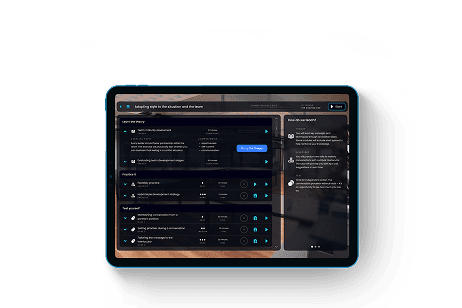
With a digital twin for realistic sales conversations, you can turn each simulation into development data and compare changing behaviors with the pipeline metrics in your CRM.
End-to-end measurement model: from baseline to revenue impact
Start with the baseline: extract a data snapshot from your CRM, listen to a few conversations from each stage of the funnel, and describe current behaviors. Next, assign 1–2 key behavioral metrics and 1–2 outcome metrics to each stage—that’s enough to keep the focus sharp. Schedule measurement intervals: after each training module and at regular intervals (e.g., weekly) in the CRM. This allows you to see whether improvements in behavior immediately translate into a flow of opportunities. And whether you might be training an element that has too little leverage in your sales model.
It’s important to analyze results broken down by segment: customer type, lead source, and sales rep experience. Without this, it’s easy to confuse seasonal effects with the impact of training. It’s also good practice to conduct a qualitative review of a few successful and unsuccessful cases once a month—the numbers will show the trend, and listening to the recordings will provide context. Only with this kind of picture can we honestly say: the training worked here, but not yet there. And that’s okay—we’ll make improvements where the leverage is greatest.
Leading Indicators vs. Lagging Indicators
Leading indicators are those you change immediately after training: how you open a conversation, the number of probing questions, and the quality of responses to objections. Lagging indicators appear later: conversion to a meeting, progression to an offer, a win, and margin. If you see improvement in the leading indicators but no movement in the lagging indicators—wait for a full sales cycle or check to see if you’re missing a link in the chain (e.g., a follow-up). When the downstream metrics are rising without an improvement in the upstream metrics—you’re getting lucky with your lead mix, but that’s not a strategy. That’s why you should track both types and monitor their consistency over time.
Control Group and A/B Testing in Sales
The fastest way to get an accurate measurement is a simple A/B test: part of the team goes through the module, and part does not yet. Compare the leading indicators after one week and the result-based indicators after a full cycle. It’s important that the groups have a similar mix of leads and experience—otherwise, differences may be due to chance. This doesn’t have to be a complicated study—all you need is a clear plan and consistent reporting. This ensures that the effect isn’t just a regression-to-the-mean illusion.
CRM Integration and Platform Telemetry
Link the short training modules to fields in the CRM: “opening the conversation,” “quantifying the problem,” “responding to objection X.” Telemetry from the simulations will populate these fields automatically or semi-automatically, and you’ll see how a specific habit correlates with moving opportunities forward. The shorter the module, the easier it is to establish a rhythm: you practice in the morning, and in the afternoon you check the initial results in the CRM. This closes the data loop and reduces guesswork. And the team can clearly see which competencies have the greatest impact on their process.
ROI and budget: lower OPEX costs + up to 100% KFS funding
Traditional training often eats up the logistics budget: venue, travel, hotels, per diems. A model based on short online modules cuts OPEX, because you pay for access and results, not for an “event.” This immediately improves ROI, even before you factor in the increase in efficiency. Add to that faster onboarding of new hires, and you have a tangible cost-and-time advantage. And when training sessions are broken down into short blocks, you don’t disrupt your team’s sales rhythm.
The second component of ROI is external funding. In many cases, you can take advantage of support covering up to 100% of the costs under the KFS program. If you’re building a business case for the board, present two scenarios: ROI without a grant (savings + impact on metrics) and a scenario with a grant, where the break-even point drops to practically zero. This gives decision-makers a clear choice and makes it easier to get the green light.
Want to go down this path without the paperwork? Take advantage of subsidized sales training—you’ll receive a clear checklist and guidance through the formalities. This allows you to focus on what matters most: translating the training into metrics in the sales funnel. And then on verifying how the KPIs of sales training impact the pace and margin of your transactions. Simple, transparent, and with no surprises in the budget.
Mistakes in KPI Reporting and How to Avoid Them in Practice
Most often, we stumble over “pretty” metrics that don’t actually change anything. We measure post-training satisfaction rather than the presence of specific behaviors in sales conversations. We report in aggregate, without segmentation, so we can’t see where the training works best. Or we focus only on the final metrics, ignoring the fact that the sales cycle spans several weeks or months. Each of these pitfalls can be fixed, as long as you give the data context and rhythm.
In practice, a simple set of rules helps: less, but more precisely; focus on behaviors; and always maintain control. Below is a list of red flags worth keeping in mind when reviewing dashboards. When one of them pops up, pause and check whether you’re confusing correlation with causation. This saves many hours of discussion about “impressions” and shifts the conversation to what’s visible in the pipeline.
- Vanity metrics: Training NPS without behavioral metrics or funnel impact
- No control group or a different mix of leads in comparison groups
- Reporting only on a monthly basis—no weekly leading indicators
- No segmentation (industry, lead source, experience)—the average obscures the effect
- No mapping of modules to CRM fields—difficult to prove the chain of causality
If you want to quickly verify whether your KPIs are driving sales, run a small pilot and review the data after one cycle. In real life, comparing call recordings with CRM data provides the most insight—you can hear what’s changed and see if it’s working. And when you want to see what such a measurement looks like end-to-end in simulations, just schedule a demo. You’ll see that implementation can be both fast and measurable. No bells and whistles—just the numbers.
Frequently asked questions
What are the most useful sales training metrics?
The most useful sales training metrics combine observable behaviors with commercial outcomes. Track whether salespeople set an agenda, uncover issues, quantify value, and handle objections, then connect those behaviors to meetings booked, stage conversion, deal velocity, margin, and renewals. This makes it clear which skills influence the pipeline rather than simply showing training activity.
Which financial metrics help evaluate sales training improvements?
Financial metrics should be reviewed alongside behavioral and CRM data. Useful measures include margin, discount deviation from the target level, revenue progression through pipeline stages, and the cost of training delivery. Looking at these together helps you distinguish a stronger sales conversation from a result caused by lead mix, timing, or a single large opportunity.
Which inside sales KPIs should be measured after training?
For inside sales, start with first-contact quality and speed: agenda setting, time to a valuable customer insight, and conversion from call to scheduled meeting. Then measure discovery depth, objection handling, follow-up quality, and opportunity progression in the CRM. These KPIs reflect the short, repeatable conversations that shape an inside sales pipeline.