Emotional Intelligence in Sales – A Brand That Sells
How does emotional intelligence in sales build trust and influence customer decisions? Discover practical conversation techniques that boost conversion rates. Check it out.

Emotional intelligence in sales shapes how customers assess risk, trust your brand, and decide whether moving forward feels safe. In a sales call, it shows up in the voice, pauses, questions, and decisions made along the way. After half an hour, the client has not only a list of features in their head, but also an impression: “It’ll be easier with them” or “I sense a risk here.” That impression becomes your brand in their eyes, a quick mental shortcut they’ll fall back on when taking the next step. Without emotional intelligence, the brand narrative will not align with the customer’s experience.
Building a brand in B2B doesn’t end with a brand book. The brand comes to life in conversation: in how you handle silence, how you acknowledge concerns, and how you guide the customer toward a decision without pressure. A salesperson’s well-calibrated EQ turns stated values into a tangible experience—with every interaction. Sound too soft? In practice, it shortens the process, increases the repeatability of wins, and lowers the cost of customer acquisition because fewer opportunities are “wasted.” Seriously, it makes a difference.
Why Emotions Shape Brand Perception in B2B Sales
B2B is about people, too—just with greater responsibility. When the stakes involve a deployment costing hundreds of thousands and the decision-maker’s reputation, emotions become a filter for risk perception. If they sense calm, curiosity, and respect for their context during the conversation, your brand gains a second life as a “safe choice.” But if the conversation resonates with haste, defensiveness, and downplaying of objections, the brand loses ground even before an official “no” is uttered. Emotions aren’t an afterthought—they’re the medium through which the entire logic of the offer flows.
Pay attention to the micro-moments: the first opening question, the reaction to hesitation, the way you wrap things up. That’s when the customer encodes episodic memory, and that—more than a PDF brochure—builds associations with your brand. Instead of an aggressive “let’s move on to the decision,” it’s more effective to say, “Let’s pause for a moment to consider the implementation risks—what do we need to anticipate?” This approach isn’t a sign of weakness, but rather a signal of competence and control over the situation. And these signals shape your reputation.
Who is this not for? If you acquire clients almost exclusively through auctions with strict criteria and minimal human contact, the impact of EQ will be limited. In those cases, price, timeline, and process references are what win the day. In every other model—from the discovery call to the final negotiations—the emotional quality of the conversation becomes a real differentiator for the brand. And this is often the case when both offers are substantively comparable.
Emotional Intelligence in Sales and Brand Trust
Trust is built when a customer feels seen and understood, not “manipulated.” Self-awareness helps a salesperson recognize their own tension and calm their automatic “sales tics.” Empathy isn’t about guessing; it’s about testing hypotheses: “It sounds like your biggest risk is the implementation time—am I right?” Self-regulation is the ability to give the other person space when they need a moment to gather their thoughts. This triad makes up a style that customers describe with one simple word: “calm.”
In practice, most teams stumble into two recurring patterns: interrupting at a crucial moment and offering advice too quickly without a full assessment. Both undermine the brand’s image—the first sends the signal “our priorities are more important,” the second—“we’re selling a template, not a solution.” A small adjustment in language and the rhythm of the conversation changes how the message is received without changing the slides. And this translates into a greater willingness on the client’s part to share internal information, which further shortens the sales cycle.
If you want to apply these principles to your daily practice, start with simple habits: paraphrasing, acknowledging emotions, and pre-commitment (“At the end, I’ll summarize and propose two options—is that okay?”). These techniques stabilize the conversation and build implicit agreement for the next step. Looking for a ready-made path to develop these skills? Check out our sales training programs—they combine language training with realistic scenarios. This is where emotional intelligence in sales stops being just a buzzword and becomes a behavior you can call upon at will.
From Conversation to Experience: How a Salesperson Embodies the Brand
A brand is a promise. The salesperson is its real-time embodiment. If you say “proactivity,” in a conversation that means anticipating objections and clearly managing risk. If you say “partnership,” it means asking questions that sometimes complicate the process but ultimately lead to a better implementation. These values must be translated into micro-skills and measurable behaviors, not just slogans in an email signature.
An example? The procurement team says, “We’re concerned about lock-in.” A response consistent with the “transparency” brand isn’t “we don’t have that here,” but rather: “Let’s make a list of exit conditions and checkpoints—we’ll include it in the contract.” This approach shifts the other party’s emotional state from defensive to collaborative. And that’s exactly how the brand experience is born—the one customers later talk about behind the scenes.
A fair warning: this won’t work without a process. EQ needs a framework—definitions of stages, summary templates, risk checklists, and space in the CRM for the emotional context of the matter. Then every salesperson brings their own personality while maintaining the standard. Otherwise, you’re left with randomness and “it depends,” and the brand pays the price with inconsistency.
How to Measure the Impact of EQ on Conversion, NPS, and Retention
Start with leading indicators—what’s happening yesterday and today, not just at the end of the quarter. Metrics like “time to the next step after the first call” or “percentage of meetings ending with a joint summary” respond more quickly to behavioral changes. Add quality: do the notes identify customer risks and agreed-upon success criteria? If so, the conversion rate from discovery to proposal typically increases as well. And importantly—the percentage of “ghosting” after sending a proposal decreases.
NPS can be measured not only after implementation but also after key meetings in the sales process. A short, two-question survey indicates whether a conversation supports the brand’s reputation or undermines it. Add hard data: retention, cross-sell, and up-sell in the first 6–12 months—these are the results of how the initial psychological contract was established. EQ cannot replace the product, but it increases the chance of fully leveraging the value the product delivers. And that translates to a longer customer lifecycle.
Test like a scientist. Two cohorts, one time period, the same pool of leads; one group practices specific EQ micro-skills, while the other continues as usual. Measure differences in conversion rates after the first week, after a month, and after a quarter—as well as changes in NPS and the number of no-shows. Along the way, you’ll also see a side effect: shorter emails, better call summaries, and more predictable forecasts. This is a sign that the brand and the process are working as a team.
How to Scale EQ Within a Team: AI Simulations and Hands-On Learning
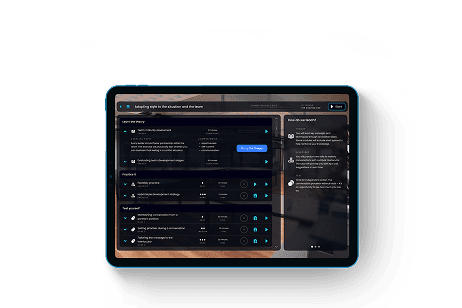
Scaling begins with safe practice. Short, realistic AI simulations allow you to rehearse scenarios—from difficult objections to negotiations—without judgment or stress. The THEORY → PRACTICE → MASTER cycle closes the loop: first, a specific technique; then, a trial run in a scenario; and finally, refinement and application to real conversations. Instant, data-driven feedback shows where you’re losing trust and where you’re building it. This makes emotional intelligence in sales repeatable and scalable.
Micro-sessions of 15–20 minutes per week, aligned with pipeline goals, work best. Personalized learning paths allow you to reinforce what most influences conversion at a given stage—for some, it’s delving deeper into needs; for others, it’s closing the deal without pressure. Technically, all you need is a web browser, and if you prefer full immersion, the scenarios also work in VR. After a few weeks, one problem usually comes to the surface: interrupting the client at the worst possible moment. A well-prepared simulation then teaches you to pause and work in silence.
And a moment of honesty: this won’t work as a one-time, 8-hour lecture. If you’re looking for a “training event” for the sake of photos, keep looking—here, we’re aiming for a change in conversational behavior, and that requires short, regular doses. The best results come when managers coach based on the same standards used in the simulations. This ensures that the brand’s language, processes, and daily feedback all speak with one voice.
Implementation and Budget: Training Funding and a Quick Start
You can get started quickly: a brief assessment, 90-day priorities, and the first scenarios tailored to your pipeline. Importantly, training subsidies of up to 100% are available, which helps minimize the barrier to entry and speed up the decision-making process. Metaskills operates in accordance with the ISO 9001:2015 standard for quality management—a guarantee of a process that maintains high standards. And if you’d rather see for yourself than take our word for it, run a short pilot before the full rollout. This way, you structure your investment in EQ into a logical, measurable sequence.
Training subsidies of up to 100%—how to take advantage of them
The process is simple: first, preliminary program qualification; then, aligning the scope with business objectives and completing the application paperwork. We help prepare the necessary documents and define metrics that will demonstrate the impact on results—from conversion rates to NPS. If your goal is to strengthen your sales teams, check out the option for subsidized sales training—it’s a practical way to build competencies without straining your budget. As a result, you’ll integrate EQ training into your operational routine faster, rather than putting it off “until better times.” And it starts working for your brand from the very first weeks.
ISO 9001:2015—a quality standard trusted by businesses
ISO 9001:2015 certification means that the process of designing, delivering, and evaluating training programs is subject to continuous improvement and quality control. In practice, this ensures consistency: clear objectives, a predictable course of action, and concrete success criteria. This is crucial when training is intended to impact not only participant satisfaction but also brand reputation and sales results. As a result, the risk of a program being “nice but ineffective” decreases, and the investment becomes justifiable when discussing it with the finance department. And that’s exactly the kind of predictability that matters when a brand needs to be credible not only in its campaigns but, above all, in its interactions with customers.
Schedule a demo and pilot—the fast track to launch
The best way to see how this works for you is through a short demo session using real-world scenarios. During the demo, you’ll assess the quality of the simulations and feedback, and see how behaviors translate into standard conversations—without risk and without unnecessary presentations. If you experience an “aha moment,” we’ll launch a pilot on a selected segment of your sales pipeline and measure the impact on conversion. Want to give it a try? Just schedule a demo and choose a time that works for you.
Read more

Can I use an AI avatar to practice conflict resolution?

How can I practice difficult employee reviews with an AI avatar?

How do AI avatars in soft-skills training improve the application of these skills in everyday work?

What soft skills can actually be developed using AI avatars?

What makes AI avatar simulations more effective for soft skills training than traditional role-playing games?