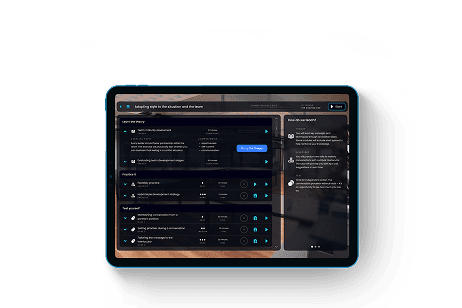
How can I practice difficult employee reviews with an AI avatar?
How can I practice difficult employee conversations with an AI avatar? You'll receive a step-by-step guide for the scenario, conversation exercise, AI coaching, and debrief.

How can I practice difficult employee conversations with an AI avatar? Managers, as well as HR and L&D professionals, will find a concrete step-by-step guide here for preparing, conducting, and evaluating realistic conversation exercises. They translate a sensitive situation into a clear scenario, experience emotional reactions without risking real-world workplace relationships, and use the evaluation to determine the next best course of action for the conversation.
Preparing for Difficult Employee Conversations as an AI Scenario
A scenario suitable for practice doesn’t start with the label “difficult conversation,” but with a precise situation. Define who is speaking, what the issue is, what the goal of the conversation is, and what behaviors need to be observed. This prevents exercises in which a manager explains a lot but fails to reach a solid agreement.
From the Reason for the Conversation to a Clear Exercise Task
Take, for example, a team leader who needs to give feedback to an employee regarding repeated late handoffs. The task, then, is not to express criticism in a friendly manner. It is to: specifically identify the behavior, describe its impact on the team, ask for the employee’s perspective, and establish a binding next step. This is how you can recognize a successful start to a conversation.
What reaction should the avatar elicit?
Define in advance how the avatar should react. In the scene, the employee says, “You don’t even realize how much extra work ends up on my plate.” The avatar may become defensive, withdraw, or show openness to clarification. The team leader must decide whether to justify herself or stick to the specific observation and ask for clarification.
Also describe the limits of the exercise: The manager should not memorize a perfect phrasing. She should learn to remain calm in the face of resistance, focus on the impact rather than assigning blame, and steer the conversation back toward a mutual agreement.
Can I use an AI avatar to practice conflict resolution conversations?
Yes, you can practice conflict resolution conversations with an AI avatar if the scenario responds to the flow of the conversation and doesn’t just ask questions in a fixed order. An emotionally responsive avatar can react to word choice, tone, and the direction of the conversation with impatience, withdrawal, or openness. This makes it clear which statements escalate conflicts and which create space for clarification.
Safely testing emotional reactions
A department head is talking to an avatar about shift assignments. When she says the decision has already been made, the avatar reacts irritably and interrupts: “So my opinion is just a formality, then.” The department head immediately experiences how a statement intended to be objective can come across as dismissive. She can address the reaction, explain the decision, and at the same time clarify the scope for further planning.
Don’t brush off conflicts-resolve them
During the exercise, the AI coach can discreetly flag it when the manager slips into a hasty justification. Instead of continuing to argue, she can, for example, ask which part of the decision is particularly problematic for the employee. Manager coaching simulations for difficult leadership conversations provide a useful reference point for designing such learning scenarios.
Repeat the same situation using a different strategy. In the next attempt, the manager can first acknowledge the other person’s perspective and then explain the decision-making framework. What matters is not harmony at any cost, but a clarification that enables effective action even in tense situations.
Which soft skills can actually be trained using AI avatars?
For difficult employee conversations, soft skills must be translated into observable actions. When considering which soft skills can actually be trained using AI avatars, the focus is therefore less on general traits and more on conversational behavior: active listening, asking precise questions, structuring statements, taking different perspectives into account, and formulating clear agreements.
Defining Soft Skills as Observable Behavior
Formulate a visible criterion for each competency. Active listening, for example, is demonstrated when the manager restates the avatar’s objection in their own words before responding. A shift in perspective is demonstrated when they consider the impact on the employee without retracting the original feedback. The GenAI analysis can highlight these moments as strengths and areas for development for the follow-up discussion.
Practicing conversation skills even under pressure
A project manager is preparing for a critical team meeting. The avatar raises objections in a random order and asks, for example, why the schedule remained unchanged despite earlier warnings. The AI coach monitors whether the project manager maintains the pace, structures her response clearly, and returns to her main point after a pointed follow-up question.
Don’t just evaluate whether an answer sounds technically correct. Check whether it remains understandable, truly addresses the question, and leads to the goal of the conversation. You can also find specific phrasing for this evaluation in the examples of feedback on communication skills.
What makes AI avatar simulations more effective for soft skills training than traditional role-playing exercises?
AI avatar simulations are not inherently superior to traditional role-playing in every training scenario. Role-playing with colleagues is useful when a group needs to reflect on different perspectives together. Avatar simulations are particularly well-suited when the same challenging conversation scenario needs to be repeated, and a manager needs to test different responses without social inhibition.
Repeatability and Comparability in Conversation Training
A traditional role-play changes with every person who takes on the opposing role. While this can be valuable, it makes direct comparison more difficult. In an avatar scenario, a manager can replay the same escalation: In the first attempt, they respond to the accusation with a lengthy explanation; in a later attempt, they summarize the objection and ask a clarifying question.
For the development discussion, no one has to rely solely on their memory of the scene. The competency assessments from the completed sessions provide a common foundation for the debriefing with the supervisor. The supervising manager can discuss with the manager in training whether they should address criticism more specifically, make better use of pauses, or finalize agreements more clearly.
When to Use a Browser and When to Use VR
The conversation scenario should remain the same regardless of the access method. In a browser, the exercise can be flexibly integrated into the preparation for an upcoming conversation. In VR, the same scene can be practiced in a spatially immersive setting. The article “Training Soft Skills with VR for Long-Term Impact” provides further practical guidance on choosing a method and using VR.
Choose the format based on the learning objective, not on the technical effect. If a manager primarily needs to review their conversation structure, the browser is often sufficient. If presence, eye contact, and situational pressure are to be part of the exercise, VR may be a better fit for the occasion.
From the First Attempt to Targeted Repetition in Employee Reviews
A good training sequence combines an unvarnished first attempt with clearly defined feedback. Start with a feedback session in which an avatar reacts defensively to criticism. The manager begins without interruption so that word choice, pauses, and the handling of resistance become apparent under realistic pressure.
Use coaching sparingly during the conversation
A manager explains to an avatar that their behavior during a client handoff did not meet the agreed-upon standard. The avatar replies that the guidelines were never clear. If the manager then loses their train of thought and starts defending only the details, the AI coach can prompt them to return to observation, impact, and clarifying questions.
Do not provide prompts for every imprecise statement. Too much support turns a conversation exercise into guided text production. Intervene when the person loses sight of their goal, evades the avatar, or further escalates the situation with accusations. This ensures that responsibility for the conversation remains with the manager practicing.
Translate the evaluation into better next steps
After the session, the leader discusses the GenAI evaluation with their supervisor. They identify a strong moment-such as an open-ended follow-up question-and select a specific change for the next iteration. This might involve identifying the impact of the behavior earlier or finalizing an agreement more precisely. The next exercise tests this specific change rather than re-evaluating the entire conversation in abstract terms.
How HR Teams Can Identify a Suitable Platform for AI-Powered Soft Skills Training with Avatars
When deciding which platform for AI-powered soft-skills training with avatars is suitable for HR teams, don’t stop at a compelling demo. Check whether the solution enables repeatable conversation exercises and whether the results can be discussed in a way that is transparent to executives, learners, and managers.
Criteria for Scenarios, Coaching, and Evaluation
- The avatar should be able to react emotionally to what is said, rather than simply reciting a rigid script of questions.
- Coaching during the exercise and a transparent competency assessment after the session should work in tandem.
- The same conversation scenario should be available in both the browser and in VR to ensure that the scenario logic remains consistent.
- A debriefing session with the leader should highlight which conversational behaviors change between exercises and what will be practiced next.
How to Integrate Exercises into Leadership Development
Test the platform using a conversation that actually occurs in leadership development, such as feedback on collaboration or performance. After a session, an HR Business Partner can check with the manager to see whether the evaluation identifies specific behaviors and whether this leads to actionable follow-up. If you’d like to explore how such an approach can be supported, you’ll find information on AI-powered soft skills and leadership training.
Don’t plan the exercise as a standalone session. Integrate it before a real conversation, follow it up with a brief debriefing with the manager, and agree on which conversation scenario to practice next. This way, a simulation becomes a meaningful component of leadership development.
Schedule a demo if you’d like to practice difficult employee conversations with emotionally responsive AI avatars in a browser or in VR.
Frequently Asked Questions
How can I improve my conversation skills with an AI avatar?
Improve your conversation skills by practicing a specific conversation scenario multiple times and focusing on changing just one behavior at a time. Start without assistance, use the AI coach’s prompts during critical moments, and then review the GenAI evaluation. For your next attempt, choose a specific action, such as asking for more details or formulating an agreement more precisely.
How do AI avatars in soft skills training improve implementation in everyday work?
AI avatars make the application tangible because managers don’t just discuss a realistic conversation-they conduct it themselves. They experience the reaction to their choice of words and can retry a difficult passage. The evaluation links the conversation to observable behaviors, allowing supervisors and learners to identify specific changes to implement in their next real-life conversation.
Which platform for AI-powered soft skills training with avatars is suitable for HR teams?
A suitable platform combines emotionally responsive avatars, coaching during the conversation, and a transparent competency assessment after the exercise. It should be able to simulate the same conversation scenario in both a browser and in VR and support a debriefing session with the manager. It is crucial that HR teams can adapt scenarios to typical leadership situations and discuss progress made through repeated exercises.
Can a difficult employee conversation be practiced in a browser and in VR?
Yes, the same conversation scenario can be practiced in a web browser and in VR. The web browser is suitable when managers need to train flexibly and from any location. VR may be appropriate when the physical setting and the immediate presence of the other person are part of the challenge. The conversation objective, avatar reaction, AI coaching, and GenAI evaluation all remain aligned with the same scenario logic.
Read more

How do AI avatars in soft-skills training improve the application of these skills in everyday work?

What soft skills can actually be developed using AI avatars?

What makes AI avatar simulations more effective for soft skills training than traditional role-playing games?

How to Run Difficult Performance Review Conversations

Branching Scenarios for Soft Skills Training