How to Run Difficult Performance Review Conversations
Learn how to run difficult performance review conversations with evidence, a calm response to pushback, and a clear improvement agreement.

How to run difficult performance review conversations starts with a clear case, not a scripted verdict. This guide is for managers, HR business partners, and L&D leaders who need to address a performance gap without making the employee defensive or leaving the meeting without direction. You will get a practical structure for preparing the discussion, handling emotion, agreeing improvement, and rehearsing the moments that most often go wrong.
Prepare the evidence, purpose, and next step before the meeting
Turn opinions into observable examples
Do not enter the meeting with a conclusion such as "you are unreliable" or "you do not take ownership." Those are judgements about a person, and they invite a debate about character. Separate what you observed, the effect on work, and any assumptions you have made about why it happened.
For example, write that a project update was submitted after the agreed deadline and that a colleague could not complete a client handover. Do not add that the employee did not care unless you can discuss behaviour that supports that interpretation. Focus on the performance pattern with the greatest consequence rather than arriving with every frustration from recent months.
Decide what a useful agreement would look like
Set the purpose before you write your opening. You need to clarify expectations, understand barriers, agree support where it is appropriate, and establish a point for reviewing progress. A difficult review is not useful if the employee leaves knowing they have disappointed you but not knowing what must change.
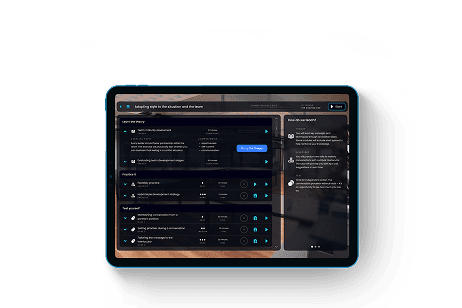
Practise the opening before the live meeting. In a role-play, a manager tells an AI employee avatar, "I want to discuss the missed handover and agree what needs to be different next time." The avatar becomes guarded when the manager adds a broad claim about attitude. On a repeat attempt, the manager removes the claim and keeps the message specific and fair.
Open the performance review without triggering defensiveness
A direct opening managers can adapt
Start by stating why you are meeting and why the issue matters. Recognise the employee's contribution if it is relevant, but do not use praise to bury the concern. Ambiguity may feel kinder in the moment, yet it often produces confusion and a harder follow-up conversation.
You might say: "I want to talk about the reliability of project handovers. In the recent handover, the update arrived after the agreed point, which held up the next stage of work. I would like to understand your perspective and agree what needs to change." Then pause. The pause is part of the opening, not an uncomfortable gap to fill with more explanation.
What to say when the employee disagrees immediately
In practice, an avatar may respond, "That is unfair. The deadline changed and nobody helped me." A team leader who counters with "That is not true" too quickly turns the meeting into a contest. A steadier response is: "I hear that the change in deadline affected your work. Talk me through what happened, and then we will return to the handover requirement."
This approach gives the employee room to explain without withdrawing the concern. Teams building this capability across managers can use manager coaching simulations for difficult one-to-ones to practise the opening and the response that follows it.
Describe the gap through behaviour, impact, and expectation
Replace labels with evidence
Use a disciplined sequence: describe what happened, explain the impact, then state the expectation. This keeps feedback on work rather than personality. Labels such as "careless," "uncommitted," or "difficult" rarely produce an actionable response because the employee can reasonably challenge them.
Say, "The customer notes were incomplete when the case moved to the service team. They had to contact the customer again, which delayed the resolution. For each handover, the case notes need to include the agreed details before it moves forward." The message is firm, but it gives the employee something concrete to address.
Make the expected change observable
Be precise about whether you are discussing an isolated error, a repeated pattern, or an expectation that was never made sufficiently clear. Each calls for a different managerial response. Treating a misunderstanding as defiance can damage trust; treating a repeated pattern as a one-off can leave the underlying problem untouched.
During a practice conversation, an emotionally responsive avatar initially withdraws after hearing, "You need to be more professional." The manager replaces that accusation with the case-notes example and the required standard. The avatar then becomes more open, and the manager asks, "What will you do differently at the next handover?" Ask the employee to reflect the expectation back in their own words. If they cannot, you do not yet have shared understanding.
Respond to anger, silence, and pushback without lowering the standard
Validate emotion without abandoning the message
An emotional reaction is information, not a reason to abandon the conversation. Acknowledge what you see without accepting an account that the evidence does not support. When an employee is angry, slow the pace and use a neutral tone. When they are silent, leave enough space for an answer before repeating the question.
If the employee says, "You are blaming me for a wider team problem," respond with, "I can hear that you see the situation differently. I want to understand the wider context, and I also need us to address the handover that was within your responsibility." This protects dignity while preserving the standard.
Questions that uncover barriers to improvement
Ask questions that reveal what is getting in the way: "What made this difficult to complete as agreed?" "Which part of the expectation was unclear?" "What support or capability do you need to meet it?" Explore workload, role clarity, confidence, and competing priorities. Do not make excuses for the employee before you have heard their answer.
In a rehearsal, an avatar responds to a difficult point with impatience and short answers. The manager feels pressure to explain faster. The manager receives real-time AI coaching during the conversation, then tries again, asks one neutral question, and waits. The avatar then identifies an unclear ownership boundary that can be addressed without removing accountability.
Different reactions require different responses, which is why branching scenarios for practising different employee reactions are useful for manager development. Rehearse denial, frustration, withdrawal, and genuine readiness to improve rather than assuming every employee will react in the same way.
Turn the review into a specific improvement agreement
From promise to observable commitment
Do not close with "Please improve" or "I will try harder." Those phrases create no reliable basis for a later review. Ask the employee to suggest practical actions first, then add the expectations and support you are prepared to provide.
Agree what output or behaviour will demonstrate progress, what support is needed, and when you will revisit the commitment. A useful agreement might state that handover notes will be complete before work is passed on, that the employee will raise a risk early if they cannot meet that requirement, and that you will review examples together at the agreed point.
How to close firmly and respectfully
Where the situation requires it, state the consequence of insufficient improvement clearly and proportionately. Avoid threats or vague warnings. Say what you will assess at the follow-up and what will happen if the required standard is still not met, in line with your organisation's performance process.
In a second role-play attempt, the avatar remains vague after the manager says, "I need you to do better." When the manager turns this into a specific agreement, the avatar becomes more constructive and proposes how they will flag a delivery risk. Close by asking the employee to summarise their commitment, then summarise your own: the expected change, the available support, and the review point. This exposes different interpretations before they become a later dispute.
Best field training solutions integrating scenario simulations with performance feedback and coaching
What to review after each practice conversation
Consistent performance review conversations require more than a policy document or a briefing for managers. Build practice around situations managers repeatedly face: a capable employee who denies the issue, someone who goes quiet, a colleague who blames workload, or an employee who is ready to improve but needs clearer direction.
Let managers rehearse with emotionally responsive AI avatars, receive real-time coaching, and repeat the same conversation after adjusting their approach. After each attempt, a GenAI assessment of soft skills follows the conversation. Focused repetition gives managers a chance to work on the difficult moment again before the live review.
For a one-to-one coaching discussion, managers can review their own practice exchange and the GenAI assessment that follows the conversation. Instead of relying on broad advice such as "be more confident," they can identify a rushed response to pushback, an unsupported label, or an agreement that lacked an observable expectation. That gives the manager a concrete behaviour to work on before the live review.
When browser and VR practice fit different manager groups
Browser practice can suit managers who need to rehearse from their usual workspace or fit short practice sessions around operational work. VR can fit facilitated learning where presence and the pressure of a face-to-face exchange are part of the learning objective. The same scenario can run in either format, so the conversation standard remains consistent.
Structured rehearsal supports managerial judgement; it does not replace it. For teams that need realistic practice, real-time coaching, and GenAI assessments of soft skills, AI soft skills and leadership training for difficult conversations provides a practical option for preparing managers before consequential meetings.
Book a Metaskills demo to see how your managers can practise difficult performance conversations with responsive AI avatars, in-the-moment coaching, and structured assessment.
Frequently asked questions
What should a manager say at the start of a difficult performance review conversation?
State the purpose, name the specific performance issue, explain its work impact, and invite the employee's perspective. For example: "I want to discuss the delayed handover, the effect it had on the next stage of work, and what we need to change." Pause after the opening so the employee can respond before you interpret or defend your assessment.
How do you handle an employee who becomes defensive during a performance review?
Acknowledge the reaction calmly, then return to the observable facts and the purpose of the discussion. Ask an exploratory question about what happened rather than arguing immediately. You can recognise that the employee feels the assessment is unfair while remaining clear that the performance issue still needs to be understood and addressed through a specific next step.
How specific should feedback be in a performance review conversation?
Feedback should identify a situation, the behaviour or output observed, the consequence for work, and the expected change. "Be more reliable" is too broad to act on. Explain what reliable delivery looks like in the employee's role, including what they should do if a risk emerges. Ask them to restate the expectation to confirm that both of you understand it the same way.
How can managers practise difficult performance review conversations before a live meeting?
Managers can rehearse a realistic scenario with an AI avatar that reacts with defensiveness, silence, impatience, or openness. Real-time coaching can support managers during the conversation, while a GenAI assessment follows the completed conversation. Choose practice that lets managers repeat the same difficult moment and apply feedback immediately.