AI Pilot Formats for Retail Digital Conversion Lift
Test retail sales conversations with AI pilot formats, track measurable behaviours and connect practice to digital conversion lift.

For retail teams, AI pilot formats can test digital conversion lift and measurable results before training is scaled. An AI sales training platform replaces long lectures with short, hands-on practice that sticks. Reps don’t just “learn”; they rehearse high-stakes conversations in a safe space and get immediate feedback on what they actually said, not what they meant to say. Think objections, negotiations, price pressure, and those first 30 seconds on a cold call. It’s practical, measurable, and built for the real world where targets don’t wait. And when you want the full picture of skills covered across the funnel, take a look at our sales training.
Here’s the simple idea: practice real conversations, improve business results. The platform simulates customers with realistic 3D avatars, brings in real‑time coaching, and serves short, focused modules you can complete between calls. Faster onboarding, lower OPEX, and a tangible lift in conversion don’t come from theory; they come from behavior change you can see and measure. In practice, most managers notice reps start asking better questions, pacing their voice more deliberately, and handling price pushback with less panic. No fluff, just reps talking to customers — even if it’s a virtual one.
Why Traditional Sales Training Leaves Money On The Table
Classic workshops feel productive while you’re in the room, but Monday comes and most of it evaporates. You paid for venues, travel, and hotels; you pulled your team off the phones; and you got a binder of slides that rarely turns into new behavior. The hidden cost is opportunity cost: days without prospecting, demos that slip, and managers spending hours re‑explaining techniques in 1:1s. When learning is passive, your people understand the idea but can’t execute it under pressure. That gap shows up in stalled deals and discounts you didn’t plan to give.
There’s also a scalability problem. If you run a dispersed sales network — hundreds or even a thousand plus locations — the quality of coaching varies wildly. One region nails value selling while another defaults to price. Traditional sessions are events, not systems, so consistency fades as soon as the trainer leaves. Meanwhile, new hires wait weeks for the next cohort, losing momentum and motivation. You’re essentially paying more to move slower.
Finally, measurement is fuzzy. Post‑workshop surveys don’t correlate with pipeline movement. Without objective, behavior‑based feedback on real conversations, it’s hard to prove what changed. Leaders end up relying on anecdotes, and budget discussions become a fight between belief and spreadsheets. A repeatable practice system with immediate, clear feedback flips that script and ties learning directly to the moments that decide deals.
How The AI sales training platform Works In Practice
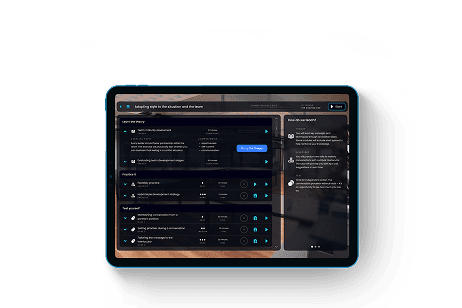
The flow is simple: learn the essentials, practice in a realistic conversation, then master the scenario without prompts. Everything is built to help reps internalize the craft, from objection handling and value messaging to hard negotiations and cold openers. You can speak naturally, type, or choose responses — whatever matches how your team sells. Real‑time coaching keeps you on track in the moment, and final feedback shows strengths plus clear improvement points. It’s learning in action, not in theory.
Learn: Short, Targeted Concepts
Each module starts with concise, easy‑to‑navigate slides that spotlight exactly what matters for the upcoming conversation. You’ll refresh core ideas like value framing, discovery sequencing, and margin defense without drowning in jargon. The goal is to set a clear mental model that you can test right away. Reps get just enough theory to make practice effective, not enough to stall them at the whiteboard. This keeps momentum high and context tight.
Practice: Realistic AI Simulations With Coaching
Next comes the live conversation with a realistic 3D avatar that reacts to tone, content, and pacing. The system mirrors real customer behavior — from the polite brush‑off to the hard‑nosed negotiator — so reps feel the pressure and learn to navigate it. Real‑time guidance nudges them toward stronger questions, tighter value language, and cleaner closes, building procedural memory you can trust under quota. Scenarios span the full funnel: cold calling, discovery, handling “too expensive” and “send me the offer,” and end‑game negotiations. If you also want sharper communication beyond sales, you can plug in soft skills training with AI to reinforce listening, empathy, and clarity.
Master: Free Practice And Actionable Feedback
Finally, reps run the same conversation without hints, then receive comprehensive feedback. They see where they built trust, where they lost control, and how specific moves — a better question here, a tighter summary there — could have changed the outcome. Strengths are highlighted, and improvement areas are concrete, so the next run is immediately better. Over time, the platform adapts to preferred learning styles, dialing up practice or theory as needed. That means faster progress for veterans and a steady ramp for new hires.
Personalized Paths, Browser And VR, Clear Feedback — What Matters
Personalized learning paths are the engine behind consistent progress. Reps who need more practice on objections get more reps; those who struggle with discovery get targeted modules that tighten their questioning and listening. Because it works in a browser and in VR, you can train anywhere — at a desk, on a laptop in the field, or in a headset when total focus helps. Multiple response modes let people speak naturally, type when that’s faster, or choose from options during early learning. The result is high adoption without forcing everyone into the same mold.
Clear, behavior‑based feedback is the difference between “feels good” and real improvement. When a rep sees where their phrasing triggered price sensitivity or where they missed a buying signal, the fix becomes obvious and repeatable. You don’t need a coach in every room to raise the bar; the system makes expectations visible and attainable. In practice, most people notice they start slowing down, connecting the dots for the customer, and closing loops they used to leave open. That’s the kind of feedback loop that compounds across a quarter.
Who is this not for? If you only want a once‑a‑year offsite with motivational slides, this approach will feel too hands‑on. If you don’t plan to measure behaviors or you prefer training as an “event,” you won’t get the compounding gains a practice system creates. But if your goal is predictable sprzedaż performance — the kind that shows up in the forecast — giving reps daily, low‑friction practice is the fastest lever you can pull. The platform meets people where they are and nudges them forward one conversation at a time.
Proof Of Impact: Faster Onboarding, Short Modules, Lower OPEX
The picture is straightforward. Teams onboard faster because modules are short and focused. Savings on OPEX come from eliminating logistics, hotels, and travel; you pay for access, not for an event. Most importantly, replacing passive theory with behavioral training translates to a lift in conversion by building procedural memory and automating objection handling in real time. That’s the kind of line‑of‑sight impact revenue leaders care about.
Consider onboarding a class of SDRs and AEs. Instead of waiting for a trainer’s calendar, they start day one, practicing the exact calls and meetings they’ll face in the field. Managers review objective feedback rather than piecing together shadow notes, and coaching time shifts from catching up to leveling up. As a result, the first real customer conversations happen earlier and go better. If you want a deeper dive into skills and scenarios covered, explore our sales training.
Operationally, the simplicity matters. Browser and VR access mean there’s no classroom to book or travel to fund, which is why budget owners like the model. For frontline reps, the promise is even simpler: finish a module over lunch, try it with a customer in the afternoon. Wins reinforce the habit faster than any slide deck could. That’s how a training line item turns into a revenue lever.
From Retail AI Pilot Formats To Measurable Results
Getting started follows a tight loop: align on the business goal, target group, timelines, and budget; choose the right pilot format; then launch scenarios that reflect the conversations your retail teams actually have. For a digital conversion goal, that might mean practising product recommendations, value conversations, objections, or the handoff between online interest and a sales conversation. The pilot gives you evidence about which behaviours need attention before you commit to a wider rollout.
Measurement starts with observable actions rather than vague impressions. Managers can review how reps open a conversation, ask questions, connect the offer to customer needs, handle price pushback, and agree the next step. You can compare those behaviours across groups and connect the learning review to the conversion stage you want to improve. That creates a clearer line between an AI training pilot and the business result it is meant to support.
Once the pilot shows where the strongest opportunities are, scaling is operational, not heroic. Provision access, assign paths, and let managers track progress through clear, behavior-based dashboards. New hires plug in on day one; veterans target their blind spots without sitting through material they have already mastered. Because the same scenarios run the same way everywhere, a retail network can build a consistent customer experience while keeping the training adaptable to local needs.
Choosing The Right AI Pilot Format For Retail
The best format depends on the retail moment you want to improve and how your team works today. A focused scenario pilot can target one conversation, such as a product recommendation, a price objection, or the handoff from online interest to a sales discussion. A browser-based pilot makes it easy for dispersed teams to practise in the flow of work, while VR can create a more immersive setting when the conversation benefits from full attention. You can also combine both formats so the same scenario is available in the environment that suits each rep.
Whatever the format, keep the pilot tied to observable behaviour. Define what a stronger opening, better discovery, clearer value message, or more confident next step looks like before practice begins. Then use the feedback from repeated scenarios to see which behaviours need more attention and which format supports adoption. This gives retail leaders a practical basis for deciding what to scale, rather than choosing a format on preference alone.
Scenarios Across The Funnel: From Cold Call To Negotiation
A practice system is only as good as the conversations it puts in front of your team, so the scenario library follows the funnel rather than a curriculum. Reps rehearse first contact, discovery, value conversations and the end game, in the order deals actually unfold. Each stage has its own failure mode, and each one is drilled on its own until the moves feel natural. A rep who opens well but folds on price gets practice where it hurts, not another pass through the basics.
Cold Calling: The First 30 Seconds
The opening decides whether there is a conversation at all. Reps practise the hook that earns permission to keep talking, and they hear how tone and pacing land on the other side - the rushed pitch, the flat delivery, the pause that gives the buyer room to answer. The avatar reacts the way real prospects do, from the polite brush-off to genuine curiosity, so the rep learns to read those first seconds and adjust. Repetition here is what turns a script into a voice.
Discovery: Questions About Impact, Not Features
Weak discovery produces a list of requirements; strong discovery produces a reason to change. Reps practise sequencing questions that dig into consequences - what the problem costs, who feels it, what happens if nothing moves - instead of running a feature checklist. They also practise listening long enough to let an answer finish, which is where most of the useful detail hides. Sharper notes at this stage make every later conversation shorter.
Value Selling: Tying The Solution To The Outcome
Value selling is the habit of connecting what you sell to the result the buyer wants, in the buyer's own words. Reps practise framing the solution against that outcome rather than the spec sheet, so price becomes one part of the conversation instead of the whole of it. They learn to summarise back what they heard, then build the case on top of it. When the outcome is clear, discounting stops being the only lever available.
Negotiation: Protecting Margin Under Pressure
The end game is where good work quietly leaks away. Negotiation simulations apply real pressure and ask reps to hold the line on margin without stalling the deal: give and take instead of one-way concessions, and every concession structured so that it buys something back. Reps practise trading rather than caving, and they see the difference it makes to the close. The aim is not to beat the buyer - it is to protect value while both sides keep moving.
The Three Objections Every Rep Hears
Most deals wobble on the same handful of sentences, so those get their own drills. Reps run them until the answer comes out calm, short and credible - and until the pause before it disappears.
- "Too expensive" - practise moving the conversation back to the outcome and the cost of doing nothing before you defend the number.
- "I need to think about it" - practise finding out what the hesitation really is and agreeing a concrete next step instead of accepting a polite stall.
- "Send me an email" - practise earning another minute on the call and turning a brush-off into a specific reason to talk again.
Industry Context Changes The Conversation
The same skill looks different depending on who you sell to, so scenarios adapt to the setting. In Retail & FMCG the priority is consistent service across a dispersed network, where a customer should get the same quality of conversation in every location. In Finance & Banking it is trust and compliance: reps practise being clear and careful at once, saying enough to build confidence without straying past what they are allowed to promise. In B2B & SaaS the pressure comes from C-level conversations and shorter cycles, where a rep gets one meeting to sound credible to someone who thinks in outcomes rather than features. If you want to see how those stages line up with your own pipeline, the mapping sits inside our sales performance training.
What The Feedback Actually Measures
Feedback only changes behaviour when it names the behaviour. After each conversation a rep sees how they did against criteria they can act on: listening, empathy, structure and objection handling. Listening covers whether they let answers finish and picked up what mattered. Empathy covers whether the customer felt understood before being sold to. Structure covers whether the conversation had a shape - opening, discovery, value, next step - or wandered. Objection handling covers what happened when the pushback arrived. Named criteria give managers and reps the same vocabulary, which is what makes coaching short and specific instead of vaguely encouraging.
Frequently asked questions
What are AI training platform sales pitch examples?
Examples include opening a retail conversation, discovering what the customer needs, presenting value instead of features, responding to “too expensive,” and asking for the next step. An AI training platform lets reps practise these sales pitch examples with a responsive avatar, receive coaching during the exchange, and review specific behaviours afterwards.
How can a retail AI pilot support digital conversion?
A retail AI pilot gives teams a controlled way to practise the conversations that influence digital conversion, from product recommendations to objection handling and follow-up. Managers can define the target behaviours, review performance across scenarios, and use the findings to decide which paths, groups, or customer moments deserve a wider rollout.
What makes results from an AI training pilot measurable?
Results become measurable when the pilot uses clear, repeatable criteria such as listening, structure, empathy, value messaging, and objection handling. Reps receive the same type of feedback after each scenario, while managers can see where performance improves and where more practice is needed before connecting those changes with broader conversion goals.
Read more