Training for difficult patient conversations
Breaking bad news, consent, strong emotion, the family in the corridor - the conversations clinicians learn on real patients. Where to practise them instead, and what to look at afterwards.

The part of the job that nobody rehearses
Difficult patient conversations training gives clinicians somewhere to rehearse bad news, consent, strong emotion and family talks before facing them with a real patient. The procedure itself you practised under supervision, on a model, then with someone senior watching over your shoulder. The conversation that comes after it you had for the first time on a real person, alone, with no second attempt.
Ask clinicians which part of their week they would most like to do better and it is rarely a technique. It is the conversation where a diagnosis has to be said out loud. It is the consent form that needs to mean something. It is the frightened person talking themselves into a decision they will regret, and the son in the corridor demanding answers. Nobody hands you a place to practise those.
What goes wrong is usually not the information
Most people who struggle with these conversations know the content perfectly well. What comes apart is the shape of the exchange - the order things are said in, the pace, what happens in the silence, and whether anyone checked what the patient actually took away.
Breaking difficult news
The common failure is speed. The news arrives all at once and is followed immediately by a treatment plan, because the plan is the comfortable part and the silence is not. The patient hears the opening words and stops processing; everything after them is noise. What has to be practised here is not gentleness. It is warning, pausing, and finding out what has landed before adding anything else.
Consent that is genuinely informed
A signature is easy to obtain. Understanding is not. Consent conversations drift towards recitation - risks listed at speed in the language of the discipline, a pause for questions that invites none, and a form signed by someone who mainly wants the interaction to be over. Practising this means practising the uncomfortable part: asking the patient to tell you back, in their own words, what they think is about to happen and what they are agreeing to.
The patient who is frightened, angry or in tears
Strong emotion in the room pulls most of us towards explaining harder, or towards getting out. Both escalate. The behaviour that has to be trained is staying, naming what you can see, and letting the emotion have its moment instead of treating it as an obstacle to the agenda. This is the hardest thing to acquire from a textbook, because reading about it costs nothing and doing it costs a great deal.
The conversation with the family
Relatives arrive with their own fear, their own reading, and often their own disagreements. They ask questions the patient has not asked, sometimes questions the patient does not want answered. The skills in play are boundaries without coldness: being clear about what you can share and with whom, giving relatives something concrete to do, and keeping the patient at the centre of a conversation that is being held around them.
Why the usual training does not shift it
Communication teaching in healthcare usually arrives as a model - a sequence of steps with an acronym, taught in a lecture theatre, remembered until the following week - or as role play with colleagues, which fails for an entirely human reason: the colleague playing the patient likes you. They break character, they laugh, they let you off. Nobody wants to make a friend cry in a training room, so the version that gets practised is the easy one.
Then there is frequency. These sessions happen occasionally, in a group, with an audience. The feedback is impressionistic and generous - that was fine, maybe slow down a bit - and by the next morning nobody can recall what was said, in what order, or which sentence made the patient close up. Without a record there is nothing to improve against.
What repeatable practice actually looks like
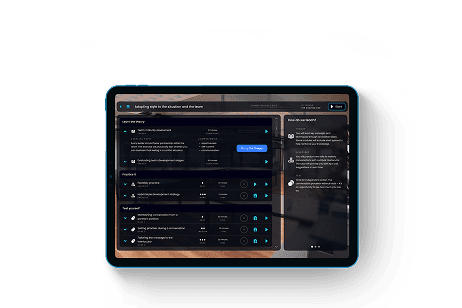
The alternative is unglamorous: short, repeated attempts at the same conversation, against something that does not go easy on you, with a record you can look at afterwards. This is where simulated conversations earn their place. A clinician talks to an AI avatar playing the patient or the relative - in a browser between clinics, or in a VR headset when the department wants the full presence of the room - and the avatar stays in character, which is exactly what a friendly colleague cannot do.
What makes that useful is what exists once the conversation ends:
- a full transcript, so the moment things turned is visible rather than remembered;
- an assessment against stated criteria - clarity, empathy, checking understanding, holding the boundary - so the feedback is about behaviour rather than impression;
- a suggestion of how to say a particular line differently, which is the piece most people are missing: they can tell an attempt went badly, but not what the better sentence would have been;
- a recommendation of what to attempt next, so a learner moves from a compliant patient to a resistant one, or from the patient to the family in the corridor, rather than repeating whatever they already find comfortable.
Repeated over time, this stops being a set of isolated exercises and starts to form a competency profile - a picture of which conversations a person handles steadily and which they quietly avoid. Ward and department leads get a view across the team, which is less useful for ranking individuals than for noticing that everyone in a unit is weakest at the same thing. That is a training decision rather than a personal one. If you want to see how these scenarios are put together for clinical teams, that is set out on the page about communication training for healthcare professionals.
Fitting it into a department with no spare afternoons
The mistake is to treat this as a new programme. It works better bolted onto what already exists. Pick the handful of conversations that recur in your unit - the diagnosis your specialty delivers most often, the consent discussion that generates the most complaints, the relative who turns up at the wrong hour. Let people attempt them alone, badly, without an audience, as often as they like.
Then use the group time you already have - a teaching session, a supervision slot, a workshop day - for the part a simulation cannot do. That is where you talk about why someone froze, what the culture of the ward does to these conversations, and what a colleague did differently in the same scenario. Blended this way, each half does what it is good at: the simulation supplies the repetitions and the record, the room supplies the judgement and the debrief.
It also helps to be specific about who practises what. A junior doctor who has never delivered bad news, a nurse who absorbs most of the family questions and a consultant who chairs the family meeting are not working on the same skill. Scenarios should follow the role, not the department.
Being honest about what it does not do
A simulated patient will not tell you whether your clinical decision was right. It does not replace supervision at the bedside, and it will not manufacture the weight of a real family in a corridor at the end of a night shift. What it offers is narrower, and more useful: somewhere to be clumsy first.
That is the whole argument. Not that a simulation stands in for the thing itself, but that the alternative - learning these conversations on people at their most vulnerable, with no record and no second attempt - is simply the method the profession has quietly accepted for a long time. It is worth recognising that it is no longer the only one.