How can you practice sales using AI, in a browser, and through VR?
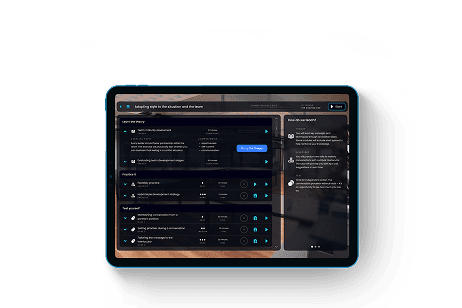
Effective implementation of AI-powered sales training combines a realistic scenario, in-session coaching, post-session evaluation, and common criteria for practice in both the browser and VR.

To answer the question of how to practice sales using AI, in a browser, and through VR in a way that effectively develops salespeople’s skills, you need to design repeatable conversations rather than simply providing yet another set of materials to work through. For sales directors, training managers, and business HR professionals, this means selecting the right scenarios, coaching methods, assessments, and defining the manager’s role so that the training leads to visible behavioral change.
AI for the Sales Department: Start with Conversations That Matter
AI for the sales department should start with a specific point where the team consistently loses the quality of the conversation. This could be the initial contact, qualification, needs assessment, price discussion, or agreeing on the next step. A broad library of topics looks good on paper, but it blurs accountability for specific behavioral changes.
Define the behavior first, then choose the technology
It’s worth working with managers to identify observable behaviors during a conversation: the opening approach, the quality of questions, paraphrasing the customer’s responses, and how the next step is confirmed. For example, in a first-contact simulation, a salesperson hears the avatar say, “Why should I spend time on this conversation?” If the salesperson immediately begins presenting the offer, the customer remains distant; if the salesperson first assesses the context, the avatar can elaborate on the issue.
The scenario should correspond to the stage of the sales funnel
The same scenario should be grounded in the rules by which the team identifies a valuable lead and decides whether to proceed with the conversation. A helpful reference point is the rules for qualifying B2B leads before the first conversation. In practice, the focus should not be on whether the salesperson has memorized the opening line, but rather on whether they have obtained the information needed to take a meaningful next step.
An effective sales simulation cannot be a matter of reading from a script
A scenario has a starting point, but it shouldn’t lead every participant to the same conclusion. You need to describe the client’s business situation, their constraints, their objections, and the conditions under which they change their mindset. Then the client doesn’t respond according to the next step in the script, but reacts to what they’ve actually heard.
An objection is meant to trigger a decision, not the next step in the script
In a conversation about price, the avatar may, after the first response, say that the offer is out of range and begin to wrap up the meeting. When the salesperson defends the price without assessing the situation, the client reacts with impatience and withdrawal. The AI coach can highlight the moment when the conversation shifted from diagnosis to price defense, but the participant decides for themselves whether to return to questions about the consequences of the problem and the decision criteria.
The customer’s reaction should be justified
The avatar’s openness, irritation, or distance must result from the salesperson’s behavior, not appear randomly. It’s worth designing the scenario to reward accurate paraphrasing, probing questions, or an honest agreement on the next step. It’s a mistake to reward only expected words, because the customer isn’t buying a sales script-they respond to the meaning of the conversation.
Customer Needs Assessment: Exercises with an AI Avatar
Exercises in customer needs assessment should be broken down into short conversation segments that can be repeated multiple times: an opening question, probing the issue, clarifying the impact, and confirming understanding. This breakdown helps identify at which stage the salesperson takes control of the conversation too early. The goal is not to create a long list of questions to read off.
Questions should be practiced in context, not as a list
A client avatar might give a curt answer to the question: “What’s your biggest problem today?” However, when the salesperson asks about a specific situation-for example, the impact of delays on the client’s team-the client becomes noticeably more open. This moment demonstrates the direct link between the precision of the question and the client’s willingness to engage in conversation.
The evaluation should distinguish between curiosity and interrogation
After the trial, the GenAI evaluation can identify the questions that led to the needs assessment, as well as those after which the salesperson immediately moved on to the product. The manager should check whether the salesperson responded to the customer’s answers rather than simply checking off items on a list. The conversation framework should be supplemented with guidelines describing how to conduct a needs assessment in sales.
Coaching during the conversation should support the customer’s decision, not provide a ready-made answer
Real-time AI coaching is useful when it pertains to a specific action and occurs at predetermined moments. A prompt may appear after an objection, before moving on to the value proposition, or when the customer begins to lose engagement. A pre-written prompt gives the appearance of fluency but does not develop the independence needed outside of a simulation.
The prompt should focus on behavior
During a difficult conversation, the avatar reacts with impatience because the salesperson interrupted him several times and quickly proposed a solution. The AI coach signals the need for a follow-up question but does not formulate the entire response for the participant. The salesperson must decide for themselves what they want to clarify and how to phrase a question that aligns with the client’s words.
Assistance during the simulation cannot replace reflection after the simulation
After the session, the prompt should be compared with the evaluation of the conversation. If the system indicated the need to explore the topic further, and the sales representative’s question remained superficial, the topic should be revisited in the next attempt. The manager does not need to comment on every sentence-it is enough to work with the employee to identify the behavior that needs to be changed in the next conversation.
Which tools allow you to manage salesperson certification and competencies?
When selecting a tool for salesperson certification, verify that the assessment addresses behaviors observable during a conversation. A common rubric should describe, among other things, needs assessment, handling objections, demonstrating value, and agreeing on the next step. A manager’s general impression is not sufficient as a basis for deciding whether a salesperson is ready to conduct meetings independently.
Certification should be based on behaviors observed during a conversation
After each session, the GenAI evaluation should highlight strong points, behaviors to improve, and the rationale for the evaluation. A new sales representative may initially assess the client’s situation correctly but still end the conversation too quickly without determining the next steps. In that case, the next simulation should focus specifically on closing the deal, rather than the entire conversation from the beginning.
The manager needs material for the development discussion
During a development discussion, the manager compares the evaluation of a previous attempt with a later evaluation and asks about changes in specific behaviors. This ensures that the discussion focuses on the facts of the conversation, rather than the employee’s general level of confidence. When comparing solutions, it’s worth examining the features of AI platforms for sales training, as the selection process should verify the inclusion of simulations, coaching, and competency assessments. The ability for a manager to review results should be considered a separate criterion to evaluate when selecting a tool.
The browser-based platform and VR should serve the same training objective
The browser-based platform and VR should not constitute two separate development programs. The same scenario, evaluation criteria, and expected behaviors must apply regardless of the format. The difference lies in how the practice is organized: the browser facilitates regular, short practice sessions within the team’s work rhythm, while VR allows participants to practice situations perceived as more challenging.
Accessibility and immersion can coexist within a single program
During onboarding, a new sales representative can go through successive practice sessions for initial contact, needs assessment, and closing the deal-first in the browser and then in VR. The avatar reacts emotionally to the salesperson’s statements in both formats, and the participant receives real-time coaching and a GenAI evaluation after the conversation. Readiness to interact with a customer should be assessed based on the quality of their behavior, not on the number of training modules completed.
It’s best to start implementation with a pilot program featuring clearly defined behaviors
The pilot should cover a single type of conversation, shared evaluation criteria, and regular managerial review. The pilot can be considered successful when each participant consistently demonstrates, in the same scenario and without prompts, the behaviors indicated in the evaluation rubric; only then can the scope be expanded to include negotiations, price discussions, or value-based selling. For teams that want to compare this model with their own process, AI-based sales training will be helpful.
To learn how to implement AI simulations into sales conversation training for your team, we recommend scheduling a Metaskills presentation.
Frequently Asked Questions
Does AI for the sales department replace a manager’s coaching?
AI for sales does not replace a manager. It enables safe practice of conversations with an avatar, real-time coaching, and post-session evaluation. The manager sets priorities, interprets behavior in the context of the role, and works with the employee to determine the next scenario to practice. It is the manager’s involvement that translates the evaluation into a concrete development plan.
How should exercises for assessing customer needs be designed in an AI simulation?
Customer needs assessment exercises should be based on a real-world customer context, not on a generic set of questions. It’s important to define the problem, its consequences, and the information the salesperson should obtain. The avatar can provide brief answers to general questions but offer more detailed responses to questions that are accurately contextualized within a business situation. The evaluation should assess the salesperson’s reaction to the customer’s responses.
Can the same sales scenario be implemented in a browser and in VR?
Yes, the same sales scenario can work in a web browser and in VR if the conversation’s common goals and evaluation criteria remain consistent across both formats. The browser is suitable for regular practice between meetings, while VR is ideal for practicing situations that are perceived as more engaging. The format must not alter the expected standard of the conversation with the customer.
How can you confirm salespeople’s readiness for certification after simulations?
When analyzing which tools can be used to manage sales representatives’ certification and competencies, look for an assessment based on a common behavioral rubric. Readiness is confirmed by consistent quality in identifying needs, responding to objections, and agreeing on next steps. The manager should discuss the evaluation with the employee and identify areas for further practice.