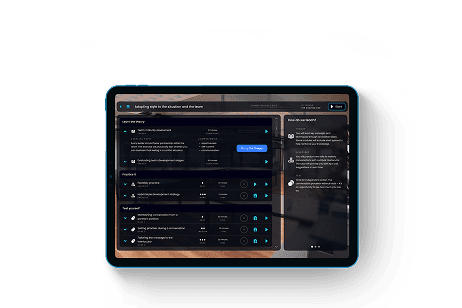
Competency Digital Twin: Assessment of Soft Skills and Sales Skills
A digital twin of competencies, as well as soft and sales competencies, can be translated into observable behaviors during conversations. The model helps evaluate performance and conduct development discussions.

The competency digital twin organizes soft skills and sales competencies as observable behaviors of a sales representative during a conversation with a customer. For those responsible for L&D, sales, and team development, this is a way to move from general assessments to observable behaviors, hands-on practice in simulations, and concrete material for managerial discussions. The model does not assess personality. It shows readiness to act in specific sales situations.
A “digital twin” of competencies for a sales team is a behavioral model, not a personal profile
Conversation context, behavior, and evaluation criteria
The competency digital twin combines a sales situation, the salesperson’s observable behavior, the other party’s reaction, and clearly defined evaluation criteria. It does not say that a given person is a “good negotiator” or a “poor listener.” Instead, it indicates, for example, whether during a discussion of needs, the salesperson asks about the consequences of the problem, paraphrases the customer’s response, and checks to see if they understand it correctly.
The scope of such a model may include establishing initial contact, assessing needs, responding to objections, presenting value propositions, and agreeing on the next steps. Soft skills should also be described in conversational language. When a customer responds in an impatient tone, the assessment focuses on whether the salesperson notices the signal, adjusts the way the conversation is conducted, and does not ignore the tension.
Why a list of competencies isn’t enough
A list of competencies alone is convenient for documentation, but it says little about what needs to be practiced the next day. In the onboarding scenario, a new hire makes initial contact with an avatar, moves on to asking questions about the customer’s situation, and suggests continuing the conversation. Subsequent attempts show whether these behaviors become consistent, rather than merely confirming knowledge of sales principles.
Understood in this way, the model provides a common language for the employee and the manager. Metaskills Academy programs are based on simulated conversations with AI, structured feedback, and behavioral practice. This approach is useful when the goal is to prepare for a conversation, rather than to permanently label an employee.
AI for the Sales Department: How Does It Build a Digital Twin of Competencies?
Scenarios as a Source of Observation
AI for the sales department requires scenarios grounded in real moments within the sales process, rather than a general test of knowledge about the product offering. A conversation after the initial contact looks different from a needs assessment, and a meeting where the customer questions the price is yet another scenario. Each of these situations reveals different behaviors and requires separate criteria.
In the pricing exercise, after the first objection, the customer avatar may lose trust in the sales representative and begin to move toward ending the meeting. How the scenario branches depends on the salesperson’s reaction. If they immediately start defending the price instead of asking about the source of the concern and the expected value, the AI coach can highlight that very moment.
Feedback based on behavior, not on a general impression
After the session, the evaluation should refer to specific statements, the sequence of questions, and the avatar’s responses. This way, instead of a generic message like “you need to handle objections better,” the employee receives specific guidance-such as that they moved too quickly to offer a discount or failed to verify what the customer was comparing. This type of feedback provides a basis for rehearsing the exact same situation again.
The simulation results should be kept separate from HR decisions. The digital twin is intended to support development and managerial feedback, not to automatically determine an employee’s evaluation. Companies that want to see how to combine scenarios, in-the-moment coaching, and evaluation of the conversation can explore an AI platform for sales training based on conversation simulations.
Soft Skills Training in VR: What Does a Digital Twin of Competencies Bring to the Table?
Same scenario, common criteria
Soft skills training in VR is a format for practicing conversations, not a separate competency to be measured. The criteria should remain the same regardless of whether the exercise takes place in VR goggles or in a web browser. The assessment focuses on the response to the customer, the way questions are asked, and how the next step is handled-not on proficiency with the device.
Having the same scenario available in both formats helps maintain a single development goal across different team working conditions. There is no need to design a separate behavioral model for VR. The participant’s experience differs, but the definition of a well-conducted conversation does not. The same principle underpins VR soft skills training for managers and teams, where one scenario runs in a headset or a browser.
The Avatar’s Emotional Response as a Training Element
In a difficult conversation, the avatar may react with impatience, withdrawal, or greater openness, depending on what it hears. An employee who speeds up the presentation after a customer makes an emotional remark sees the effect of their decision in the subsequent course of the dialogue. An AI coach may point out during the session that an emotional cue was overlooked, and the post-session evaluation highlights behaviors that strengthen or weaken the connection.
VR makes sense in situations where it’s worthwhile to provide participants with the conditions for focused practice in responding under pressure. However, it should not replace every form of training simply because it’s a new format. The choice of environment must be based on the nature of the exercise and its availability within the organization.
Which tools allow you to manage the certification and competencies of salespeople?
From Course Completion to Demonstrated Behavior
In the certification process, what counts is meeting the defined criteria for the conversation, not simply completing the course material. The tool should allow you to assign a scenario to a specific skill, such as needs assessment, handling objections, or determining the next step. In this way, confirmation of readiness is based on behavior that has been tested in practice.
When selecting a solution, it’s important to verify, above all, the clarity of the evaluation criteria, the ability to assign them to a scenario, and the material available for the manager to review after the session. Data protection policies and the separation of development-related information from personnel decisions are also helpful. You should not choose a system based solely on a list of features if you do not know how it supports the development conversation.
- A criterion should describe behavior observable during the conversation, not a general employee trait.
- The script should simulate a situation in which the behavior in question is actually needed.
- The manager should receive clear materials to discuss the next attempt with the employee.
Material for the Manager’s Developmental Conversation
The manager can compare the employee’s assessment of the conversation with the follow-up attempt conducted later and check whether the way questions were asked has changed. Instead of a comment about “greater self-confidence,” the discussion focuses on whether the sales representative has stopped interrupting, delved deeper into the topic of consequences, and agreed on next steps. The description of the criteria for effectively assessing customer needs in sales also provides practical reference points.
The “digital twin” of competencies organizes practice, evaluation, and the confirmation of readiness around a single behavioral model. Certification should not be a separate administrative ritual; it should stem from the same criteria the team uses to practice conversations.
The evaluation following a conversation simulation must point to evidence, not just the result
What Should Be Included in Feedback
GenAI’s evaluation after a simulation should highlight both effective moments and behaviors requiring improvement. A single general grade is not enough, as it does not tell the employee what to change during the next conversation. It’s best to formulate the criteria in action-oriented language: ask about the consequences of the problem, paraphrase the need, and confirm agreement on the next step.
In a scenario with an emotionally responsive avatar, the customer may withdraw after a statement that downplays their concern. The evaluation can highlight that statement, as well as a later moment when the employee paused, acknowledged the customer’s concern, and reopened the dialogue. Such evidence allows us to distinguish between a response that was successful by chance and behavior that can be consciously replicated.
How to Turn the Evaluation into the Next Practice Goal
After the session, the employee should choose one specific goal for the next attempt, such as probing the customer’s response more deeply before presenting a solution. The manager can then revisit this same criterion during a development discussion. In this way, the evaluation does not conclude the exercise but rather sets the next course of action.
Avoid categories that cannot be linked to a specific part of the simulation or the behavior to be practiced. The term “better communication” is too broad to be helpful in practice. It is much more useful to specify: after an objection, ask a clarifying question before the price argument is raised.
How to implement a “digital twin” of competencies in a sales team?
Scenarios of Greatest Importance for Sales
It’s best to start the pilot with conversations whose quality directly impacts the sales process: the initial contact, needs assessment, and closing the next step. For each scenario, agree on expected behaviors, risk signals, and how the manager will use the assessment. It’s not worth starting with a broad catalog of competencies if the team doesn’t yet have a shared definition of a good conversation.
For example, in a scenario following a meeting with a client, a sales representative might end the conversation with the phrase “I’ll be in touch soon.” In the next attempt, they practice summarizing the agreements and asking for permission to make a specific follow-up contact. The avatar reacts differently when the next step is clear, and the post-session evaluation shows whether the employee has actually agreed on a mutual commitment.
The Manager’s Role After the Simulation Ends
After the exercise is complete, the manager should not limit themselves to simply conveying the result. Their task is to relate the evaluation to a real-world stage of the sales process, set a goal for the next attempt, and verify that the criteria are clear to the team. The pilot also allows you to verify whether the feedback is useful and whether the simulations support development discussions rather than creating additional administrative work.
Once the scenarios, criteria, and the manager’s role have been defined, you can choose AI-based sales training that combines practice conversations, in-session coaching, and post-session evaluation.
To see how AI scenarios, in-session coaching, and post-session evaluation can work within your sales process, we recommend scheduling a Metaskills presentation.
Frequently Asked Questions
How does a digital twin of competencies differ from a standard competency matrix?
A competency matrix typically lists skill names and the expected level of proficiency. A competency digital twin goes a step further by linking a specific skill to a concrete conversation scenario, employee behavior, customer reaction, and evaluation criteria. As a result, it identifies areas for practice and for development discussions, rather than merely a ranking on a list.
Can AI for the sales department evaluate the course of a conversation, rather than just its outcome?
Yes, AI for the sales department can support the evaluation of a simulated conversation’s flow if the criteria are described in terms of behaviors. It can analyze whether the sales representative asked a probing question, addressed an objection, or agreed on the next step. The results should be used for development and managerial review, not for automated HR decision-making.
Do soft skills training sessions in VR require different evaluation criteria than browser-based exercises?
No, soft skills training in VR does not require separate criteria if the same conversation scenario is being practiced. Regardless of the format, you can assess responses to the customer’s emotions, active listening, questions about needs, and agreeing on next steps. VR changes the conditions of the experience, but it should not change the definition of desired behavior.
How can a digital twin of competencies be integrated with sales representative certification?
Certification should be based on completing defined scenarios and meeting observable conversation criteria. When the question is which tools allow for managing salesperson certification and competencies, one should look for a solution that combines simulation practice, behavioral assessment, and a manager’s review. Confirmation of readiness is then grounded in a practiced scenario, rather than simply in completing the material.