Sales Training Based on Real Conversations
Sales training should focus on developing behaviors that are evident in conversations with customers. Find out how to combine role-playing scenarios, AI-based practice, evaluation, and managerial oversight.

Sales training should prepare salespeople for conversations that actually determine the progress of a sales opportunity, rather than merely imparting knowledge about techniques. Those responsible for L&D, sales, and HR will learn how to design a program: from conversation maps and practice scenarios to evaluation criteria and a manager’s focus on specific behaviors. This makes it easier to distinguish the training the team actually needs from a list of trendy topics.
Sales training must be based on a conversation map
It’s a good idea to start the program by breaking down the sales process into situations where the salesperson makes a specific communication decision. The initial contact, needs assessment, value proposition, response to objections, and determining the next step each require different behaviors. A list of topics alone doesn’t show whether the team can actually execute them in a conversation.
From process stage to observable behavior
A general concept, such as active listening, must be translated into audible messages. This could be a follow-up question after the customer’s response, a paraphrase of the problem, or verifying whether the salesperson clearly understands the decision-making process. An experienced salesperson conducting complex B2B conversations needs different scenarios than someone who is just learning how to initiate contact.
Why a list of training topics alone is not enough
A new salesperson can go through separate simulations of an initial contact and then revisit the same situation after receiving feedback. When the customer avatar responds briefly, the salesperson must respond with a specific question rather than moving on to the offer presentation. Readiness to speak with a customer should stem from the quality of this practice, not merely from completing the material.
Training on assessing customer needs that tests questions
If the program includes a dedicated section on assessing customer needs, the training must be based on dialogue, not on a list of questions. The salesperson should identify the customer’s problem, its consequences, selection criteria, the people involved in the decision, and the decision-making process. Only then can they verify whether the value proposition is grounded in the identified situation.
Opening questions are no substitute for a diagnosis
The scenario should assume that the customer will not provide a complete answer after the first question. In one of the trials, the avatar reacts impatiently to a question about challenges that is too broad and begins to give shorter answers. The salesperson regains the customer’s openness when they clarify a specific problem and its impact on the team’s work, rather than asking another general question.
How to Evaluate the Needs Assessment Process
The evaluation should take into account the quality of the questions, active listening to responses, paraphrasing, verifying assumptions, and a smooth transition to the next stage of the conversation. Do not reward a large number of questions if they do not stem from what the customer has said. The stages of needs assessment and examples of questions helpful in sales are presented in a practical guide to assessing customer needs in sales.
Training for KAMs on conversations about account development
Training for Key Account Managers (KAMs) should reflect the specific nature of working on existing relationships. A conversation about maintaining the partnership, changing the scope of services, or bringing a new stakeholder onto the account is not a simplified version of prospecting. The client expects you to understand their specific context, not just another generic presentation.
A script for a KAM is not a copy of a prospecting conversation
It’s worth practicing situations where an existing client becomes cautious upon hearing a proposal to expand the partnership. An avatar representing a key account may withdraw from the conversation if the KAM discusses the offer without referencing the client’s business objectives. The participant’s task is then to return to questions about the account’s priorities and only later link them to the value of the solution.
The relationship with the account as part of the conversation evaluation
When evaluating, it is important to consider whether the KAM refers to the established context of the partnership, recognizes the role of the conversation partner, and agrees on a realistic next step. Correct product reasoning alone is not enough if it ignores the relationship and the stakeholder structure. Examples of such scenarios are presented in the article on KAM training and key account development.
AI for the Sales Department as a Practical Tool
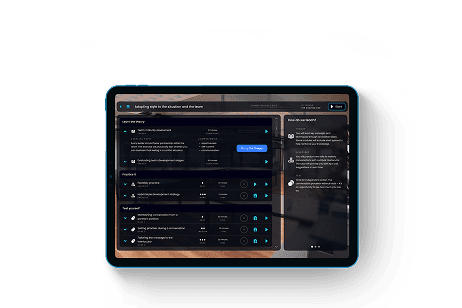
AI for the sales department makes sense when it increases the number of valuable attempts and organizes feedback. It does not relieve the trainer or manager of responsibility for the quality of the conversation and its business context. Instead, it provides an environment where a salesperson can practice without involving a real customer.
Conversation simulation instead of passive learning
The AI avatar leads the conversation and reacts emotionally to the participant’s statements-it may show impatience, withdrawal, or greater openness. During a difficult conversation about price, the customer begins to lose trust when the salesperson immediately defends the price. The scenario changes depending on the responses, so the participant sees the effects of the chosen strategy rather than just reading a description of it.
Real-Time Coaching and a Developmental Conversation with a Manager
An AI tool that provides guidance during the conversation can highlight moments when it would be better to ask a follow-up question or summarize the customer’s position. After the session, GenAI’s evaluation highlights the strong points of the conversation as well as behaviors that need improvement. The same simulation can run in a web browser or in VR, and the manager should discuss the assessment in relation to a specific sales process. The linked page demonstrates how the AI platform can be used to practice sales conversations.
How to Measure Training Effectiveness Based on Conversations
The question of how to measure training effectiveness should be considered in terms of behavior, rather than simply attendance or module completion. For each scenario, you should specify exactly what is expected of the participant. This could include assessing needs, responding to objections, demonstrating value, or agreeing on the next steps.
What to Measure Beyond Training Completion
It is most useful to compare attempts at the same type of conversation. For the same simulation, record a baseline attempt and evaluate it using a single rubric that covers the accuracy of questions, responding to the client’s answers, paraphrasing agreements, and agreeing on the next step. Each criterion can be rated as unmet, partially met, met, or consistently met. In the next attempt with the same client brief, the same rubric is applied. Progress can be recognized when a behavior that was previously unmet or partially met becomes met and is maintained throughout the entire conversation; a higher rating without improvement in the indicated behavior is not a sufficient basis for such a conclusion.
From Simulation Evaluation to the Next Attempt
After the session, the GenAI evaluation may highlight a segment where the participant accurately summarized the client’s problem, as well as a moment requiring adjustment. The next attempt should focus on one specific element of the dialogue-for example, exploring the implications of the problem in greater depth before presenting an offer. This practice plan provides the manager with a clear reference point for the development conversation.
When to Base Sales Training on AI Simulations
Simulations are particularly useful for onboarding new hires, changing the sales offering, handling difficult objections, conducting negotiations, and standardizing conversation protocols. Before implementation, however, it’s important to verify that the scenarios account for the team’s language, customer roles, and critical sales moments. A one-size-fits-all scenario is rarely sufficient for working on a conversation that is truly relevant to a specific team.
Conditions for Effective Simulation Implementation
Each scenario should have a clearly defined objective, behaviors to be evaluated, and a customer situation that requires a response. It’s also worth establishing a schedule for the manager to review practice sessions and a process for setting the next development goal. For a team that wants to practice using this model, sales training based on simulated conversations with AI will be useful, as it allows sales standards to be translated into specific dialogues.
The Manager’s Role After the Session Ends
The manager reviews the recording of the trial and the competency assessment, then relates them to the next simulation scheduled for the following week. The one-on-one discussion then focuses on the sales representative’s specific statements and decisions, rather than a general impression. One area for improvement should be identified, and then tested in a repeat scenario.
If you’re planning sales training based on practicing real conversations, it’s worth scheduling a Metaskills presentation and reviewing the scenarios with your own team.
Frequently Asked Questions
What skills should B2B sales training cover?
The program should cover the behaviors needed at each stage of the conversation: initiating contact, assessing needs, active listening, presenting value, responding to objections, and agreeing on the next step. The scope must be tailored to the role. A new salesperson needs different exercises than someone developing a relationship with a key account.
How can you tell if a customer needs assessment is being conducted effectively?
The effectiveness of training on customer needs assessment can be evaluated by whether the salesperson identifies the problem, its consequences, decision-making criteria, and the role of stakeholders. Observe whether the questions stem from the client’s answers, whether the participant paraphrases the findings, and whether they can move on to the value of the solution without guessing the client’s needs.
Do KAM training sessions require different scenarios than sales rep onboarding?
Yes. Training for Key Account Managers (KAMs) should take into account the history of the partnership, account objectives, changes in the scope of services, and conversations with various stakeholders on the client’s side. Onboarding tends to focus more on the initial contact and the basic structure of the conversation. In both cases, it’s worth evaluating observable behaviors, but the criteria and context will differ.
How can AI be used for the sales department without replacing the manager?
AI for the sales department can conduct simulations with an avatar, respond to the participant’s statements, provide coaching during the session, and prepare an evaluation of the conversation after the session. The manager continues to set the direction for development. It is the manager who interprets behaviors in the context of customers, team standards, and sales goals, and determines the topic for the next practice session.
Read more