Key Account Management Training That Boosts Sales
The Key Account Management training course teaches proven KAM practices: QBR, account development plan, stakeholder map, and governance. Find out how to implement them.

Key account management training helps your sales team turn scattered efforts into a cohesive plan for growth with strategic clients. Instead of putting out fires, the team begins to have conversations about value, risk, and the stakeholder map. Randomness disappears, and governance and a work rhythm emerge: quarterly business reviews, account development plans, and specific milestones. Sound like theory? In practice, it’s a puzzle made up of a few repeatable habits that can be practiced and implemented within the team.
Good Key Account Management training doesn’t teach you how to make “pretty slides”; instead, it changes the sales rep’s behavior when talking to buyers and end users. The sales rep stops being just a provider of proposals and becomes an account leader: they maintain a map of decision-makers, secure a sponsor, and plan cross-sell and up-sell expansion. Together with the client, they create an action plan that combines business benefits with technical feasibility. And when there’s resistance to the purchase or pressure on the price, they have give-and-takes and pricing architecture options ready. Simple.
What Is KAM and Why Does It Drive B2B Growth
Key Account Management isn’t just a title on a business card—it’s a way of managing your most important clients. The team builds a deep understanding of the client’s business: its strategy, KPIs, operational constraints, and investment plans. This leads to a value proposition—specific, quantifiable, and aligned with decision-makers’ priorities. The goal isn’t a one-time contract, but portfolio share and consistent expansion within a single organization.
How does this differ from traditional sales? In KAM, the sales representative doesn’t “have leads,” but rather manages relationships across multiple levels: end users, process owners, buyers, compliance, IT, and financial decision-makers. Each of them has different concerns and different measures of success. That’s why the account plan covers not only use cases and POCs but also risk areas, implementation scenarios, and the impact on TCO and ROI. Once you have that, the price discussion stops being a battle over discounts.
Why does the KAM drive growth? Because the greatest opportunities lie with accounts that already know and trust you but aren’t yet taking full advantage of your offering. Without an account plan, these opportunities slip through your fingers. With a plan, they grow as a predictable revenue stream: new units, new countries, new product lines. And importantly, retention also increases, because strategic clients receive genuine support rather than ad-hoc efforts centered around a tender.
Key Account Management Training in Practice for the Sales Team
The program operates on three levels: strategic thinking, operational tools, and micro-skills for conversations. First, account segmentation and priority selection; then, developing a revenue growth plan and a QBR calendar. In parallel—a workshop on specific conversations: assessing needs, guiding decision-makers toward a shared definition of success, and finalizing implementation plans. The sessions are short, action-oriented, and result in ready-to-use deliverables that the team immediately incorporates into the pipeline.
In a KAM’s day-to-day work, rituals are key: pre-meeting preparation (objective, value hypothesis, decisions to be made), a list of questions tailored to different personas, and wrapping up the meeting with a joint action plan. Next comes the follow-up, which isn’t just a “thank you for your time,” but a summary of decisions, risks, and next steps. A weekly review of account plans, and a quarterly QBR with the client and internal sponsors. This rhythm stabilizes the forecast and reduces discussions based on “gut feeling.”
If you’re looking for a starting point, check out our sales training—our approach combines hard KPIs with the psychology of growth and real-world scenarios. There are no long lectures—just hands-on practice tailored to your accounts and industry. Participants leave with a first draft of a plan and a list of conversations to have over the next two weeks. Then they return with feedback and refine the plan through subsequent iterations.
Who is this not for? If you sell exclusively low-value, short-cycle transactional products, a comprehensive KAM program may be more style than substance. If you don’t plan to involve managers in account reviews and QBRs, the results will be less than you expect. And if you’re expecting immediate growth without changing behaviors—you’re better off giving it a pass, because KAM is all about habits and consistency.
Strategic Account Plan: From Segmentation to QBR
A good account plan is a living document—it outlines direction, choices, and metrics, not just a folder gathering dust on a shelf. We start with precise segmentation, setting priorities, and defining a value hypothesis for each of the client’s business lines. Then we move on to a stakeholder map, a meeting plan, and milestones. Finally, we establish the governance rhythm: who makes decisions, when, and in what format, as well as how we measure progress. Let’s not overcomplicate things: this can all be quantified.
Stakeholder Map and the Client’s Procurement Process
The stakeholder map includes users, process owners, the business sponsor, the financial decision-maker, IT/security, and procurement. For each one, you map out their goals, concerns, and decision criteria. At the same time, you outline the purchasing process: from initiation and exploration, through validation and negotiations, to implementation and adoption. This helps you know who to talk to at each stage, what evidence they require, and what risks they’re concerned about. It shortens the path to a decision and prevents “ghosting.”
Value Proposition and Revenue Growth Plan
The value proposition must be quantifiable: results in terms of costs, time, risk, or revenue on the client’s side. In the account plan, you supplement it with a whitespace analysis—where else can you increase your share of the portfolio, and which departments, locations, or business units are within reach. You define cross-sell and up-sell paths, required decisions, evidence (case studies, POCs), and 30-, 60-, and 90-day steps. In the background, milestones and metrics—adoption, usage, and business results—are tracked. This is how a predictable, quarterly revenue plan is created.
QBR, Governance, and Risks for Key Accounts
A QBR is not just a status update; it’s a shared review of goals, results, and decisions requiring management attention. Agenda: business outcomes, risks and roadblocks, roadmap for the next quarter, and requests for support. Governance clarifies responsibilities: internal sponsors, the client-side executive sponsor, the escalation path, and the frequency of reviews. Add to that a risk register with clearly assigned owners and mitigation plans. It sounds brutal, but that’s how you win big accounts.
Negotiations and Building Influence: Conversations with Decision-Makers
A conversation with a financial decision-maker differs from a workshop with end users. You need to translate the solution’s features into financial outcomes and project risks: the cost of delays, TCO scenarios, and the impact on KPIs. Decision-makers buy into change, not features—your job is to show what will happen if the project doesn’t move forward and how you’ll mitigate implementation risks. The MAP (Mutual Action Plan) format helps: jointly agreed-upon steps, responsible parties, and deadlines.
In negotiations, preparation accounts for 80% of success: offer variants, pricing architecture, a list of give-and-takes, BATNA, and concession limits. You build packages that align value with the client’s requirements: contract duration, scope, payment terms, and references. This way, you’re not just defending the “base price”—you’re discussing configurations and outcomes. And when the procurement department gets involved, you have a script tailored to their language: supplier risks, compliance, service, and warranties.
Building influence also involves “multithreading”—deliberately expanding relationships beyond a single “champion.” Some need hard data, others want to hear about a similar company’s implementation story, and still others need a quick POC to get a feel for the solution. You learn to listen, paraphrase, and guide the conversation toward a decision without applying pressure. These are micro-skills that can be exercised like muscles—working through scenarios and regularly practicing soft skills are excellent ways to build them.
In practice, one problem usually keeps coming up: entering the conversation with the financial decision-maker too late. The solution is two-pronged—identify the sponsor early on and, at the same time, build a case for value that actually matters to the finance team. Then the final stage of negotiations becomes ironing out the details, not a battle over the budget. And that’s when the account plan shows its true strength.
AI and VR Simulations: Conversation Training with Instant Feedback
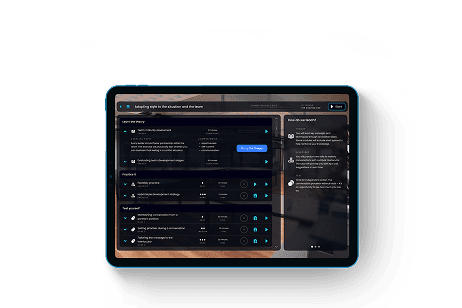
Theory without practice doesn’t change results, which is why we include AI simulations—accessible via browser and VR, no installation required, and ready to use right away. The training follows a short cycle: THEORY → PRACTICE → MASTER. First, you get a tool and an example; then, you play out a real conversation scenario with an AI “client”; finally, you refine the elements that didn’t quite work. No grading. No stress. No training room.
Feedback is immediate and data-driven: conversation structure, speaking-to-listening ratio, clarity of the value proposition, and response to objections. In practice, most people realize after their first few simulations that they’re wrapping up meetings too generally and without clear next steps. A quick iteration—a second try—and the difference is audible. That’s how you build a habit that then naturally carries over to real-world accounts.
The scenarios are realistic: a QBR with the CFO, escalating implementation risks, a price increase discussion with the procurement team, and a decision to enter a new business unit. You can tailor them to your industry and sales cycle. The team practices using their own cases, so the transfer to real-life meetings is immediate. This is where Key Account Management training translates into concrete actions on the calendar.
Want to see what the simulations and live feedback look like? Just schedule a demo. Twenty minutes is all it takes to assess where the program will deliver the fastest return on investment and how to fit it into your team’s workflow. You’ll see exactly what a session looks like and what reports the manager receives.
KAM Program ROI: Success Metrics and Training Funding
Measuring results is easy when you define them before you start. In terms of revenue, we look at: expansion within existing accounts (new units, new product lines), a higher win rate in multi-threaded sales, shorter decision-making times, and retention and renewals. The second pillar consists of qualitative metrics: adoption, utilization, and the client’s business results post-implementation. These four perspectives provide a complete picture of ROI.
Leading indicators help predict outcomes: stakeholder coverage at key accounts, the regularity of QBRs, the percentage of accounts with an up-to-date plan, and hours spent in the simulator on key conversations. If these numbers are rising, the pipeline from strategic accounts becomes more stable and predictable. Managers also have concrete data to use for coaching, rather than just “gut feelings.” And this is often the fastest way to improve the forecast.
It takes some time to see results—KAM is a change in how we operate, not a one-time workshop. That’s why we plan a pilot, establish a baseline, and conduct a review after 8–12 weeks to adjust course. The team learns through an iterative process and applies best practices to subsequent accounts. This isn’t a sprint, but the pace of growth can be surprising when the rituals take hold.
If implementation costs are a barrier, check out subsidized sales training programs. Funding is available for up to 100% of the cost, and the quality standard is confirmed by ISO 9001:2015 certification. This makes the decision easier and speeds up the program’s launch. When you combine funding with AI and VR simulations, your investment in KAM pays off not only in terms of numbers but also in the team’s confidence during key meetings.
Frequently asked questions
What does sales account management training cover?
Sales account management training covers the strategic and practical work required to grow important B2B accounts. You learn to segment accounts, map stakeholders, build an account plan, prepare QBRs, and lead conversations about value, risks, pricing, and next steps with different decision-makers.
Who should take key account management training?
Key account management training is designed for salespeople and managers responsible for complex, high-value client relationships. It is most useful when account growth depends on several stakeholders, longer buying processes, cross-sell opportunities, and consistent cooperation between the sales team and internal sponsors.
How can a team practise key account management conversations?
A team can practise key account management conversations through realistic scenarios such as QBRs, pricing discussions, implementation escalations, and meetings with financial decision-makers. AI simulations let participants test their preparation, receive feedback on their conversation structure, and try again before a real client meeting.
Read more