AI Sales Role Play Simulations That Turn Practice Into Revenue
Sales role-play training turns tough talks into closed deals. Practice 3 core skills—discovery, objections, negotiation—in safe, structured reps. See how.

AI sales role play simulations give your team a safe, structured way to practise the tough conversations that shape deals, from discovery and objection handling to negotiation. They turn confident talk into consistent outcomes by building muscle memory for the exact pressure moments that make or break deals. Think of each session as a workout plan for better sales conversations. No fluff, just reps.
Done well, role-play blends short bursts of learning with realistic conversations and clear feedback. People step in, test language, feel the emotions, and try again with better timing and tone. In practice, most managers see that two things change fastest: the quality of questions and the control of the call tempo. And when those change, win probability changes. That is the path from practice to revenue.
Why Role-Play Works In Sales: From Theory To Behavior Change
Reading a playbook builds knowledge; practicing the play builds behavior. Sales conversations are dynamic systems — words, tone, emotions, and context collide in seconds — so the best development happens in action, not in theory. When reps simulate real calls, they do more than recite talk tracks: they learn to calibrate empathy, silence, and pace under pressure. That is how you replace old habits with better ones. And crucially, practice creates a safe environment to fail forward before it is live with a customer.
Behavior sticks when feedback is immediate and specific. If a rep interrupts during discovery, instant guidance helps them catch it and try a slower follow-up question on the next turn. If they rush to discount, the scenario can pause, flag the trigger, and nudge them to explore impact instead of price. After the third or fourth rep, people stop performing and start selling. That shift — from scripted to situational — is where confidence grows.
There is one caveat. Role-play will not help if you only need product facts memorized, or if your sales motion is undefined and changes every week. It is also a poor fit if leaders refuse to protect 30–45 minutes for practice and coaching. The method thrives when there is a clear process, real scenarios, and a manager who cares about behaviors, not just dashboards.
What Great Sales Role-Play Training Looks Like Today
Modern programs feel real, scale easily, and personalize to each seller. That means avatars with authentic emotions, branching dialogue that reacts to your choices, and coaching that highlights what you said and how you said it. It also means sessions you can run in a browser or VR headset, on-demand, without travel or scheduling chaos. The foundation is simple: realistic simulations, immediate guidance, and measurable impact on conversation skills.
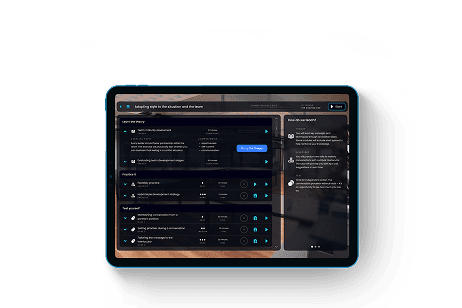
A powerful flow looks like this: learn, practice, master. First, short slides to refresh key concepts and strategies. Then, an interactive conversation with real-time coaching that nudges you toward better questions, framing, and objection handling. Finally, a “no prompts” mode to test yourself end-to-end and receive comprehensive feedback on strengths and growth areas. Multiple response modes — speak, type, or choose — let people train in the way that fits their environment and style.
Quality matters, too. Programs built on proven behavioral science, with feedback clarity on communication skills, accelerate habit change because they explain what to change and why it works. Personalized learning paths ensure a senior AE is challenged differently than a new SDR, without building separate tracks by hand. And when the platform is Browser & VR compatible and operated under a robust quality system like ISO 9001:2015 for Quality Management, you get reliability at scale, not just a one-off workshop.
Design Scenarios That Mirror Your Pipeline And Pressure Moments
Start with your pipeline. Map the conversation risks at each stage — cold outreach, discovery, multi-threading, ROI defense, negotiation, and closing — and convert them into scenarios. The closer the scene is to reality, the faster the learning transfers to live calls. If your deals hinge on consensus, build scenarios with multiple stakeholders and conflicting priorities. If your motion is land-and-expand, simulate renewal risk and expansion triggers.
Pressure moments deserve special attention. Price pushback before value is agreed, a technical blocker hijacking the agenda, or a competitor anchoring the conversation — each needs a designed response path, not a generic script. Give the avatar a personality and likely tactics so reps can learn to de-escalate, reframe, or re-negotiate in context. Real emotions teach timing better than any checklist.
Keep scenarios tight and repeatable. Ten to twelve minutes is enough for a targeted skill focus with two or three decision points that change the outcome. Add difficulty layers: first run with coaching, then with limited hints, and finally in mastery mode without prompts. This structure builds competence, then confidence, without overwhelming the learner.
One more pragmatic tip: design the debrief as carefully as the dialogue. Highlight the one or two behaviors that would have most changed the outcome — for example, validating impact before offering a discount — and have the rep immediately run the conversation again. That quick loop is where better habits lock in.
Practice With AI And VR: Realistic, Scalable, And Safe
AI-driven simulations let every seller practice critical conversations on demand, with realistic 3D avatars that react to tone, content, and timing. Real-time coaching provides guidance when it matters most, pointing out missed cues or suggesting a better follow-up question before the moment passes. Then, a post-session report synthesizes strengths and areas for improvement so managers can coach with precision. It feels like a real conversation, without the real risk.
When teams are distributed or growing fast, scale is everything. Browser & VR compatibility means you can train anywhere — laptop in a cafe, desktop at home, or headset in a quiet room — and still create immersive, consistent experiences. Multiple response modes allow sellers to speak naturally or type when privacy is needed, keeping the barrier to practice low. That accessibility is what turns occasional workshops into a continuous learning engine.
Browser And VR Compatibility: Train Anywhere
Seamless access beats perfect scheduling. With a browser-first experience and optional VR, sellers can jump into a scenario between calls, or immerse in a headset for higher-pressure practice before a big meeting. This flexibility removes travel and room-booking friction while keeping training quality consistent across offices and time zones. It is practical, scalable, and friendly to real-world calendars.
Personalized Learning Paths For Different Roles
Personalized learning paths adapt to skill level, learning style, and development stage, which means reps practice what they need, not what the agenda dictates. An SDR might focus on discovery depth and objection handling, while an AE sharpens multi-threading and negotiation framing. Leaders can assign role-specific tracks and still compare progress on shared communication behaviors. This targeted approach keeps effort high and time-to-impact short.
Instant And Post-Session Feedback That Sticks
Feedback lands when it is clear, specific, and timely. Real-time AI coaching flags missed cues, while end-of-session insights break down what improved the conversation and what held it back — from question quality to turn-taking and tone. If you want a deeper dive into how structured commentary accelerates behavior change, explore how we approach feedback in our soft skills training. The goal is simple: turn insights into the next better rep, not just a nicer report.
Measure Impact: From Conversation Skills To Revenue
If you cannot measure it, you cannot scale it. Link practice to leading indicators that move lagging revenue metrics, and track them visibly. For example, better discovery questions should show up as clearer problem statements in call notes and shorter time-to-next-step. Stronger objection handling should raise conversion rates at that exact funnel gate, not just produce longer calls. Keep the chain of evidence tight.
Use a behavioral rubric to score conversations on a few high-impact skills, then correlate those scores with CRM outcomes. Managers can coach to one or two behaviors per rep, confirm the change in the next simulation, and watch how it affects the very next live call. Over time, aggregate the data to spot coaching patterns that move the needle. That is how enablement speaks the same language as finance.
- Discovery depth: number of validated business impacts before solution talk
- Call control: agenda set-and-check and time-to-next-step clarity
- Objection handling: resolution rate at specific funnel stages
- Negotiation discipline: value restatement before any concession
- Customer sentiment signals: shifts in tone and engagement over the call
- Manager coaching cadence: time between practice, feedback, and re-test
One honest note: if you expect a single workshop to change a quarter, you will be disappointed. Impact comes from regular practice, instrumented feedback, and a tight loop into real calls and deals. Build the pipeline of skills the same way you build the sales pipeline — consistently, visibly, and with accountability. The revenue follows the repetitions.
Roll It Out Across Teams: Playbooks, Coaching, And Continuous Learning
Start small, then scale. Pick three scenarios tied to your biggest conversion leaks, run them weekly for four weeks, and review the behavioral data alongside stage conversion in your CRM. Give managers a simple coaching plan: one behavior per rep, one week to improve, and one re-test. This cadence builds momentum without overwhelming calendars.
Integrate playbooks directly into the simulations so sellers see the move at the exact moment it is needed. Encourage peer practice and short “teach-backs” — when a rep explains a move, they internalize it. Record mastery attempts and use them as micro-libraries of great calls for new hires. Certification should mean demonstrated behavior under pressure, not just a quiz.
Choose platforms that support realistic AI simulations, personalized learning paths, and Browser & VR compatible delivery, so you can expand without retooling every quarter. Clarity of feedback on communication skills helps managers coach faster and more consistently, while a robust quality framework like ISO 9001:2015 gives you confidence in process and results. The operational piece matters as much as the content when you are rolling this out across regions and roles.
Finally, keep the promise of practice alive. Protect time for it, celebrate visible behavior change, and keep scenarios aligned with your evolving go-to-market. If leadership will not back the cadence, even the best sales role-play training will underdeliver. But with sponsorship, a clear loop from practice to pipeline, and tools that make training feel like real conversations, you build a culture where performance compounds.
Set The Cadence: Weekly Reps And Monthly Capstones
Practice moves behaviour when it is scheduled, not when it is inspired. A weekly block of about twenty minutes plus a longer monthly capstone is enough to shift the way people sell, and light enough that nobody negotiates it away. Pair each weekly block with one micro-skill - open-ended discovery, isolating an objection, negotiating the next step - so the reps compound instead of scattering. In practice, by week three you will hear cleaner questions and tighter summaries on live calls.
Longer sessions still earn their place. When practice and coaching run together in one sitting, protect 30 to 45 minutes and treat it as coaching time, not a calendar filler. What matters more than the length is where the block lives: in the team calendar, with the same standing as a pipeline review. If practice is the first thing to move when the week gets busy, you do not have a programme yet. You have a good intention.
- Weekly: about twenty minutes, one micro-skill, the same slot every week
- Monthly: a longer capstone that strings the separate skills into one full conversation
- Per sitting: 30 to 45 minutes protected when practice and coaching happen back to back
- Always: owned by the manager and visible in the team calendar, not optional in busy weeks
Keep A Scenario Library, Not A One-Off Script
Scenarios are an asset, so treat them like one. A core library of six to ten scenes that mirror your market realities gives the team a shared language, and gives managers something stable to coach against. Rotate seasonal and competitive variants through that library so nobody learns to game a single script. The scenes stay familiar; the pressure keeps changing.
Build progression into the library rather than into the difficulty of one scene. Start simple - one stakeholder, clear pain, a single decision to reach - then layer complexity: several voices on the buyer side with conflicting priorities, a partial fit, a renewal at risk. Sellers should climb the library over a quarter, not survive a one-time gauntlet. That is how resilience gets built instead of merely tested.
Personas And Objections Worth Practising On Repeat
Personas carry the pressure that makes practice worth doing. A CFO avatar who turns terse when a seller meanders teaches pace faster than any note about pace. A procurement lead who becomes cooperative once the criteria are recapped precisely teaches precision the same way. A sceptical VP Finance, working with budget pressure, competing priorities and a narrow window, teaches reps to earn the second question before reaching for the deck.
Objections deserve the same rotation as the personas.
- "We built this in-house" - the seller has to explore what the internal build actually covers before comparing anything
- Price pressure raised before value is agreed - the discipline is restating impact, not moving the number
- "We will stick with what we have" - the status quo is the real competitor, and it rarely announces itself
Vary the tone as well as the tactic: busy, curious, guarded. The same scene at a different temperature is a different rep, and it costs nothing to run. Those scenes sit at the centre of our sales training, and they are the ones worth rebuilding with your own accounts and your own names on them.
Debrief In Three Questions
The debrief is where learning compounds, so keep it short and keep it identical every time. Ask three questions after every run: what worked, where did we lose momentum, and what will we try differently on the next run? Keep the answers behaviour-based and specific - the exact moment a clarifying question opened a budget thread, or the moment rushing to a demo backfired. Vague praise costs a rep the next improvement.
Then cap the feedback so it can be acted on. One "keep doing" and one "try next" for every person, every time. More than that is a list nobody remembers by the following week; less than that and the session was a performance rather than practice.
Order matters too. Let a peer give the first pass, then the manager. Peer feedback keeps the stakes low and the language shared, and it turns the rest of the team into observers rather than an audience. The manager then adds what a peer cannot see: the pattern across reps and across the quarter. Celebrate adoption openly, coach gaps privately, and the ritual becomes predictable enough that resistance drops.
Roll Out Sales Role Play Training Without The Resistance
Start with one team, one skill and two scenarios for the first month. A narrow start gives you something to point at: call snippets that show a behaviour changing, and one sentence from each rep about what clicked. That narrative earns more buy-in than any policy memo, and it costs a fraction of a company-wide launch.
Keep the technical side boring. A browser-first setup means no heavy installs and almost nothing to wait for, which removes the most common excuse for skipping a session. Add VR where immersion genuinely earns it - a high-stakes rehearsal before a big meeting - and keep it optional for everyday drills. Document the small things: how to get in, where the scenarios live, when to practise.
Then let momentum carry it. Open the weekly team meeting with one short win, so sellers watch peers improve rather than hear that they should. Keep feedback lightweight enough that it happens often. Do not over-rotate into enforcement - make participation visible, support the people who are behind, and let the habit spread the way habits actually spread.
Frequently asked questions
What is sales scenario training?
Sales scenario training gives sellers a realistic situation to work through, such as a first discovery call, price pushback, a renewal risk, or a negotiation. Instead of discussing the right approach in theory, reps practise their language, timing, and decisions in context, then receive feedback and try again.
How do sales training role plays improve performance?
Sales training role plays improve performance by making key behaviours repeatable before a live customer conversation. Reps can practise asking better questions, responding to objections, controlling the pace of a call, and protecting value in a safe setting. Specific feedback helps them identify one improvement and apply it on the next attempt.
How should you run sales role play training?
Run sales role play training around real moments from your pipeline rather than generic scripts. Assign one skill per session, use a scenario with clear pressure points, and leave time for a short debrief and another attempt. A regular cadence, manager ownership, and feedback focused on one or two behaviours keep the practice useful.
Read more